Pressing is what a team does to win the ball back: instead of waiting for the opponent to make a mistake, players close down the ball carrier and the nearest passing options together, so the opponent has less time and fewer choices. Done well, it wins the ball close to goal. Done badly, it leaves big gaps behind the players who pressed.
This guide explains what pressing in soccer means, the difference between a high press, a mid block and a low block, how cover shadows and pressing traps work, the triggers teams use, and what counter-pressing (gegenpressing) is.
In Short: Key Takeaways
- Pressing means putting the opponent under coordinated pressure to win the ball back, not one player chasing alone.
- Teams choose where to start pressing: high up the field, in midfield, or deep in their own half.
- Good pressing uses angles and cover shadows to steer the ball into a trap, usually near the touchline.
- Counter-pressing (gegenpressing) is pressing straight after losing the ball, before the opponent can organize.
Table of Contents
What Is Pressing in Soccer?
Pressing (or "the press") is a collective way of defending in which players move toward the ball and the opponents around it to reduce their time and space. The aim is to force a rushed pass, a bad touch or a long ball, and then win possession.
The key word is collective. One player sprinting at the ball is easy to pass around. A press works because the players behind them move up at the same time, cutting off the nearby passes, so that when the ball carrier looks up, every option is covered.
Why Teams Press
- Win the ball near goal: a turnover in the opponent's half leaves only a short distance to goal, often against a defense that isn't set.
- Force mistakes: players under pressure make more errors than players with time.
- Control the game: a team that wins the ball back quickly spends more time in possession and in the opponent's half.
- Stop the opponent's build-up: pressing makes it hard for a team to play out from the back, pushing them into long balls they would rather not play.
High Press, Mid Block and Low Block
The first decision is where to start pressing. Coaches usually describe three heights, named after where the team sets its defensive block.
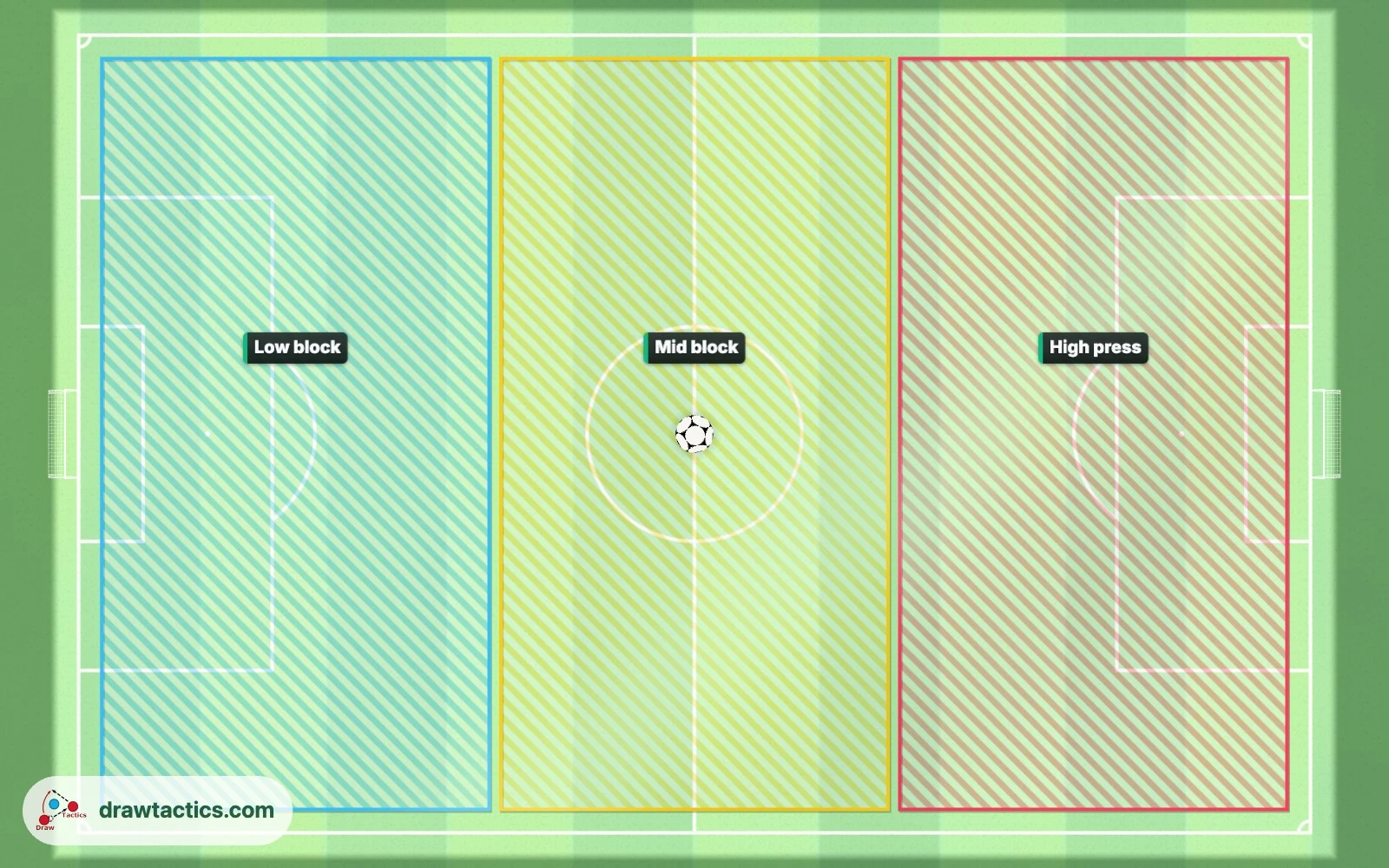
- High press: the team presses in the opponent's third, right from the goalkeeper and center-backs. It wins the ball closest to goal but leaves the most space behind.
- Mid block: the team lets the opponent have the ball in their own half, then presses once it crosses into the middle third. It's the most common choice, balancing risk and reward.
- Low block: the team drops deep into its own third and presses only near its own box. It protects the space behind the defense but gives the opponent the ball and the territory.
Most teams switch between heights during a game. A team might press high from goal kicks, sit in a mid block during open play, and drop into a low block late in a game to protect a lead.
How a High Press Works
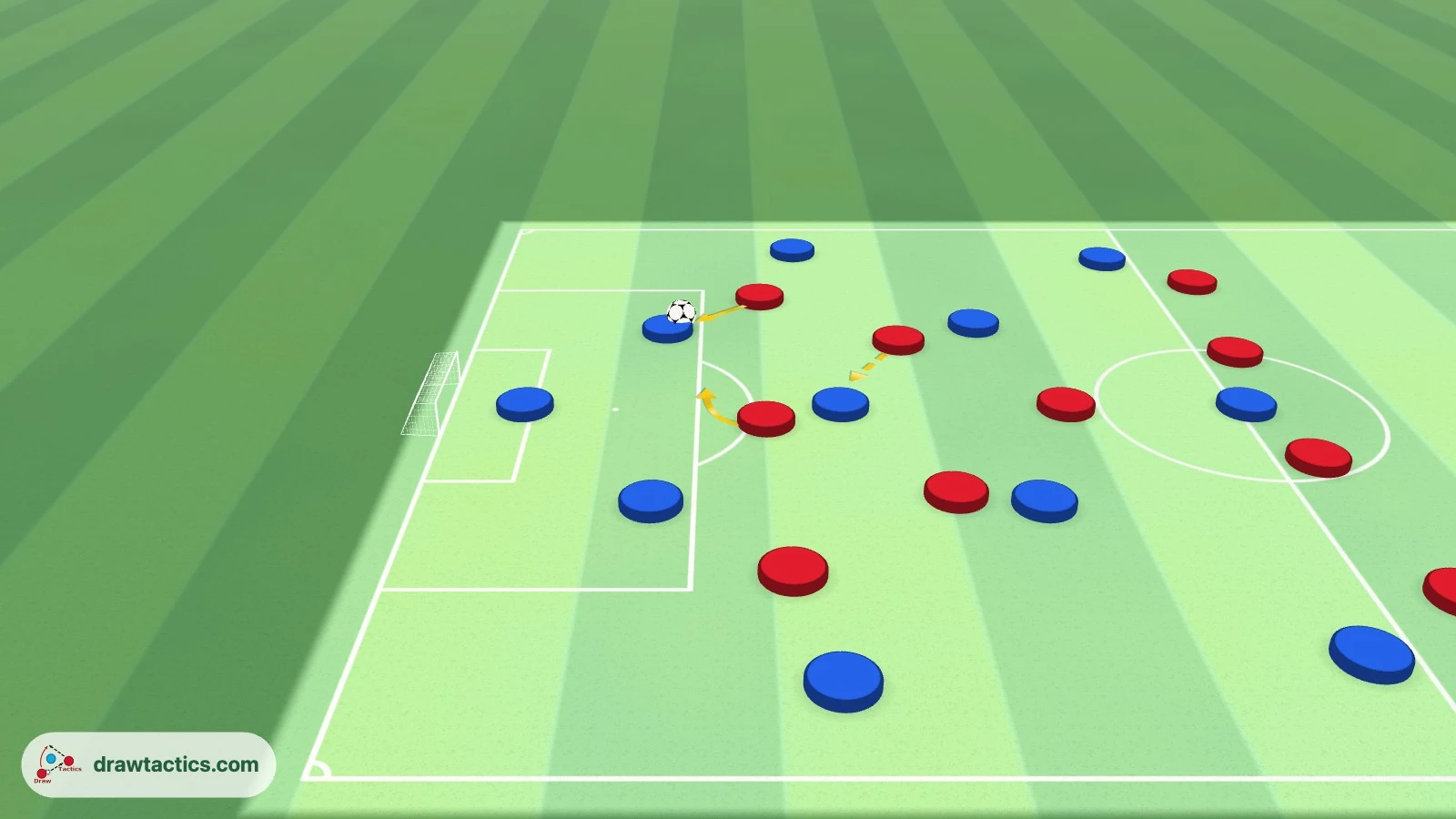
A high press starts with the forwards. In the picture above, the red winger jumps out to the center-back with the ball. The striker doesn't run straight at the other center-back; they curve their run so their body blocks the pass across. A central midfielder steps up onto the opponent's holding midfielder, so the obvious pass into midfield is gone too.
Behind them, the rest of the team moves up together. The back line pushes toward halfway to keep the team compact, which is what makes a high press both effective and risky: if the opponent plays through or over it, there's a lot of grass behind the defenders.
Cover Shadows and Pressing Traps
A cover shadow is the area behind a pressing player where a pass can't go, because the player's body is in the way. Good pressers use it on purpose: by approaching the ball carrier at an angle, they press the ball and block a pass at the same time.
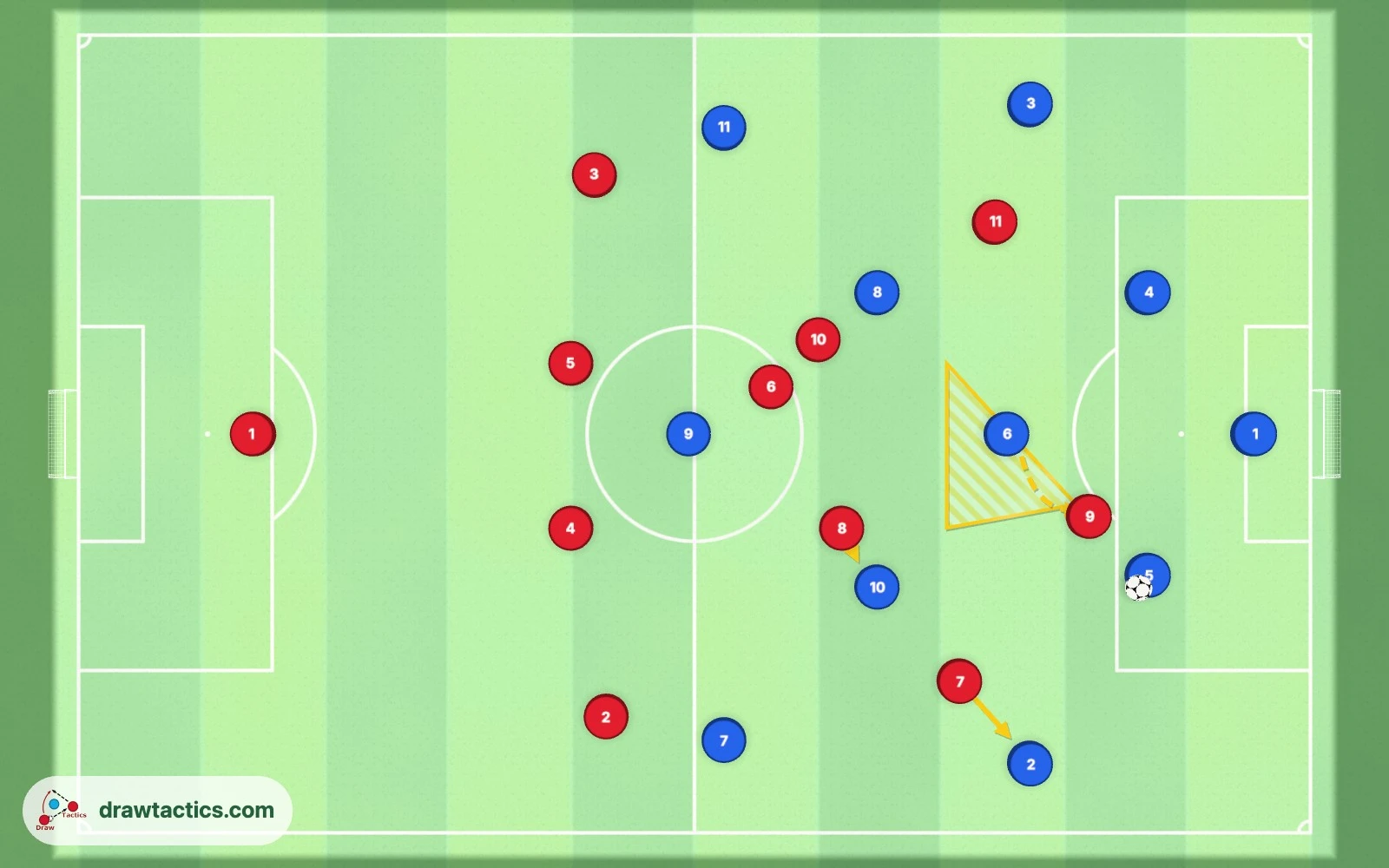
That leads to the idea of a pressing trap. Instead of trying to cover every pass, the team deliberately leaves one option open, usually a pass out to the full-back near the touchline. When the ball goes there, the winger and nearest midfielder close in, and the touchline acts as an extra defender. The full-back has no easy way out, and the press can win the ball.
Pressing Triggers
A team can't press at full speed for 90 minutes. Instead, players agree on triggers: moments that tell everyone to press together. Common ones include:
- A pass back toward the opponent's own goal, especially to the goalkeeper.
- A heavy or bad first touch.
- A player receiving with their back to goal or facing their own goal.
- A slow or bouncing pass that gives the presser time to arrive.
- A pass into the area chosen as the trap, such as out to the full-back.
- A weaker opponent receiving the ball, for example a center-back who prefers not to pass forward.
Triggers are what make pressing coordinated. When one player recognizes the cue and goes, the rest of the team goes with them.
Counter-Pressing (Gegenpressing)
Counter-pressing, often called by its German name gegenpressing, is pressing immediately after losing the ball. The players closest to the ball swarm the new ball carrier straight away, before the opponent has time to look up or move into a counter-attacking shape.
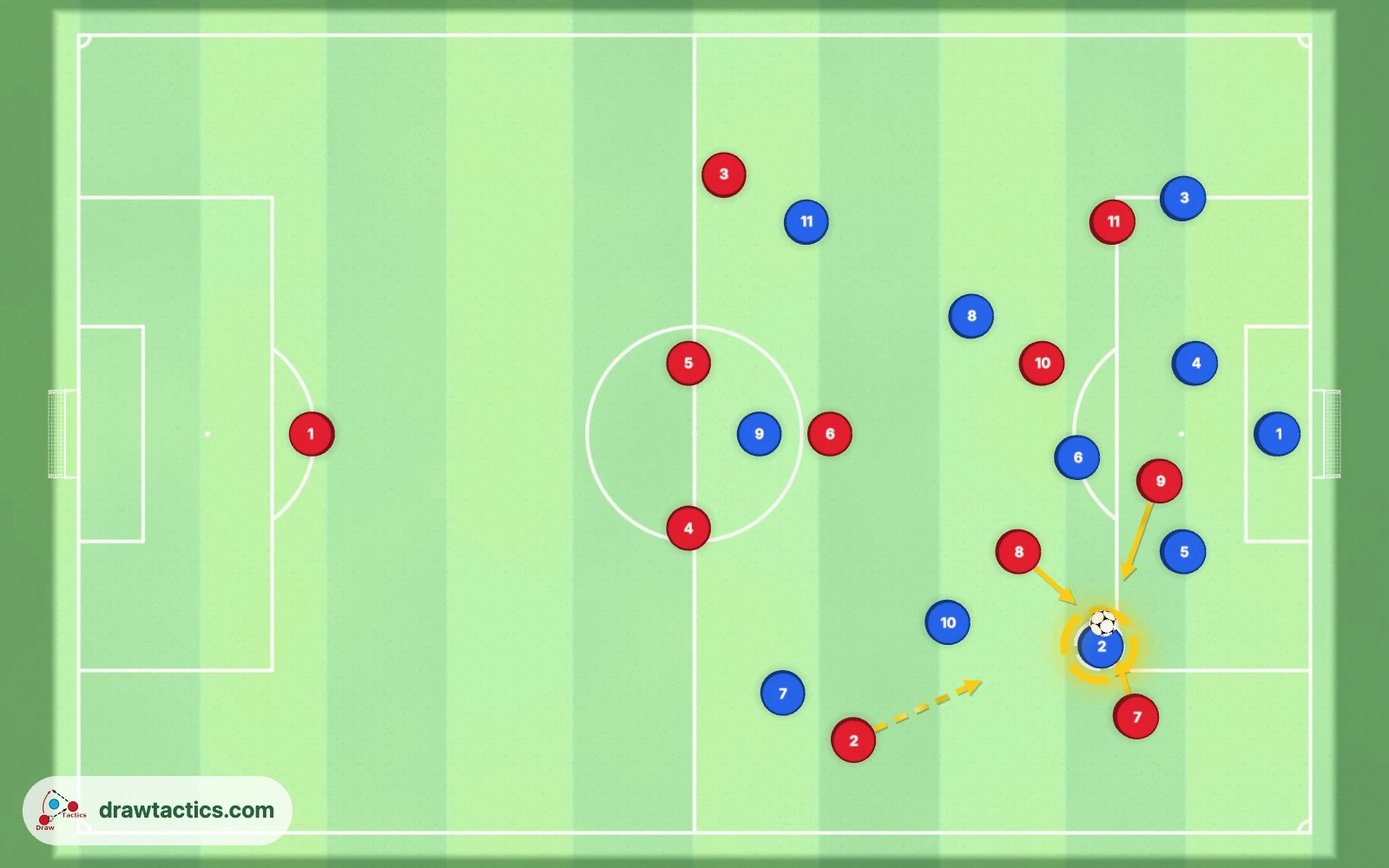
The idea is that the moment after winning the ball is when a team is most disorganized, because its players were in defensive positions and haven't spread out to attack yet. Jürgen Klopp's teams at Borussia Dortmund and Liverpool made the term famous, and Pep Guardiola's Barcelona used a similar rule: win the ball back within about six seconds, or drop back into shape.
Counter-pressing only works if the team attacks with good spacing, with players close enough to the ball to press when it's lost. That's why it's closely linked to positional play and rest defense.
Zonal and Man-Oriented Pressing
- Zonal pressing: each player is responsible for an area and presses whoever enters it. It keeps the team's shape but relies on good communication when opponents move between zones.
- Man-oriented pressing: each player is responsible for a specific opponent and follows them. It makes jobs very clear and is common in high presses, but one beaten duel can leave a whole area open.
Many teams mix the two: zonal in shape, but jumping onto a direct opponent the moment a trigger happens.
Pressing in Different Formations
Every formation can press, but each one lines up with the opponent differently.
- 4-4-2: two strikers can press two center-backs one on one, with two banks of four behind them. See the 4-4-2 guide.
- 4-3-3: three forwards can press a back four high up, with the wingers jumping to the full-backs. See the 4-3-3 guide.
- 4-2-3-1: usually presses as a 4-4-1-1, with the No. 10 stepping up to the opponent's holding midfielder. See the 4-2-3-1 guide.
- 3-5-2: wing-backs can jump high to press full-backs, but that leaves space behind them. See the 3-5-2 guide.
The soccer formations guide compares every major shape, and soccer positions explained covers who does what in each line.
The Risks of Pressing
- Space behind: the higher the press, the more space there is behind the defense if the opponent plays through it.
- Fitness: pressing is tiring. A team that presses all game without a plan will run out of energy.
- Disconnected lines: if the forwards press and the midfield doesn't follow, the opponent simply passes into the gap between them.
- Long balls: opponents can skip the press entirely with a long ball to a strong striker, so the back line needs to be ready to win the second ball.
Analysts often measure pressing with PPDA (passes allowed per defensive action). It counts how many passes the opponent makes in their own part of the field for each tackle, interception or foul by the pressing team. The lower the number, the more intense the press.
How to Coach Pressing
Pressing is learned in stages. Start with the individual skills of closing down at an angle and staying on your feet, then add a second and third player so they learn to cover and balance, and finally build team pressing with shared triggers in small-sided games.
For a full progression with practices for younger players, see our guide to teaching pressing to youth players. To plan the sessions themselves, use the free football session planner.
Showing Your Press With DrawTactics
Pressing is about movement and timing, which is hard to explain on a whiteboard. The diagrams in this guide were made with the DrawTactics Broadcast Animator. With the DrawTactics tactics board on a computer or tablet, you can set up the opponent's build-up, show your pressing angles and cover shadows, and animate the press step by step so players see exactly when and where to go.
Draw Your Pressing Plan
Map your triggers, traps and pressing heights, and share clear animated diagrams with your team.
Start with DrawTacticsConclusion
Pressing is coordinated pressure to win the ball back. Teams choose a height (high press, mid block or low block), use angles and cover shadows to steer the ball into a trap, and agree on triggers so everyone presses together. Counter-pressing applies the same idea in the seconds after losing the ball.
Whatever style you choose, the principle is the same: the player closest to the ball presses, and everyone around them moves to take away the next pass.
FAQ
What does pressing mean in soccer?
Pressing means defending by putting the opponent under coordinated pressure to win the ball back. The player nearest the ball closes down the ball carrier while teammates cut off the nearby passes, so the opponent has less time and fewer options.
What is the difference between pressing and counter-pressing?
Pressing is a planned way of defending against an opponent who has the ball, usually from a set shape and height. Counter-pressing, or gegenpressing, is pressing immediately after your own team loses the ball, before the opponent can organize a counter-attack.
What is a high press?
A high press is pressing in the opponent's third of the field, often right from their goalkeeper and center-backs. It aims to win the ball close to goal, but it leaves more space behind the defense if the opponent plays through it.
What is a pressing trigger?
A pressing trigger is a moment that tells the whole team to press together, such as a back pass, a bad touch, a player receiving with their back to goal, or a pass into the area chosen as a trap.
Should youth teams press?
Yes, in simple forms. Young players can learn to close down the ball and get goal-side early on, then add teammates covering and shared triggers as they develop. Full team pressing schemes come later.