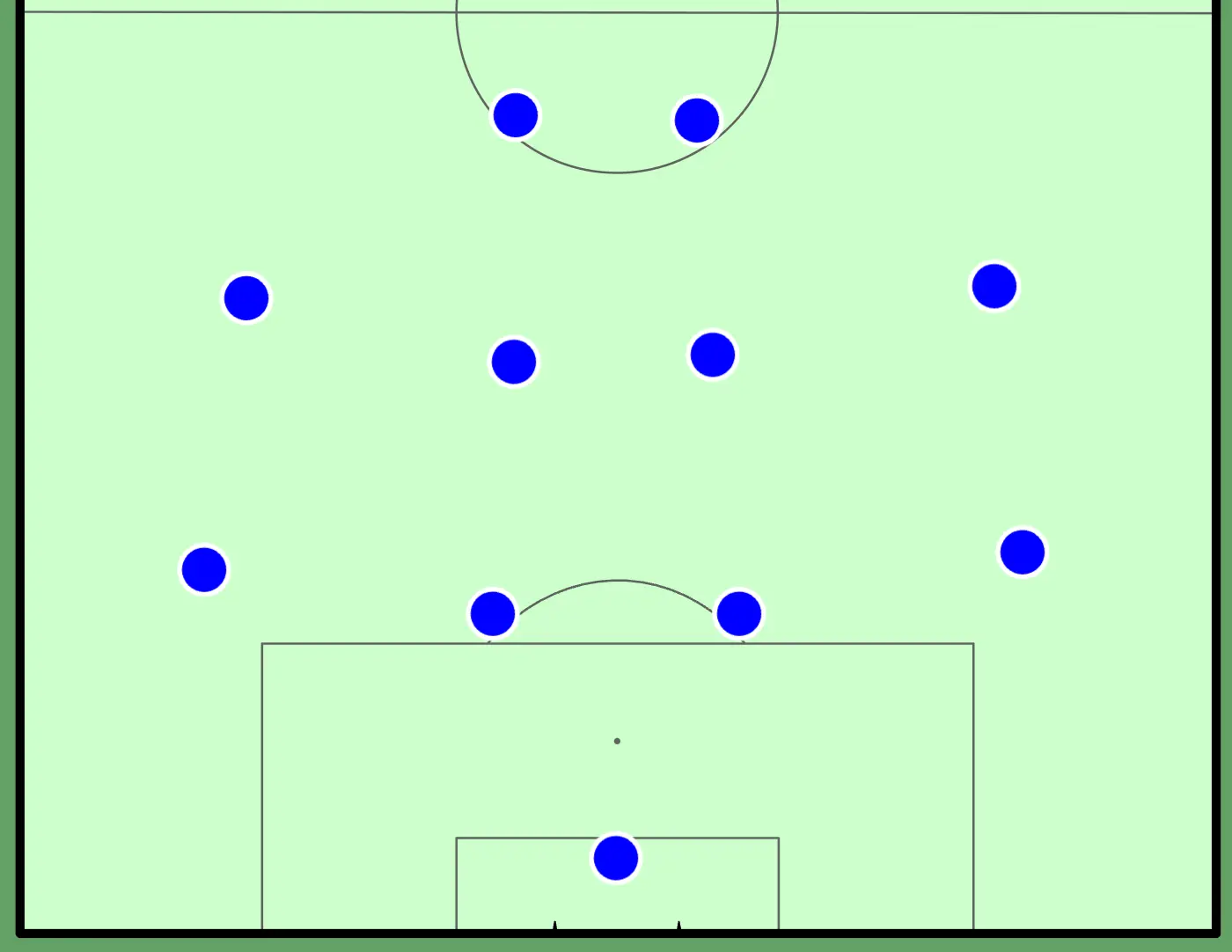
The 4-4-2 remains one of football's most enduring tactical frameworks. From Arrigo Sacchi's AC Milan to Diego Simeone's Atlético Madrid, this shape has evolved from a basic reference model into a sophisticated system for compact defending and explosive transitions.
This guide breaks down the structure, key role requirements, historical evolution, and modern adaptations that keep the 4-4-2 relevant for coaches at every level.
In Short: Key Takeaways
- The 4-4-2 excels at compactness, role clarity, and transition threat.
- Its biggest tactical challenge is central numerical inferiority vs three-man midfields.
- Modern versions solve this through asymmetries, staggered midfield behavior, and inverted roles.
- The striker partnership is a key differentiator versus lone-forward systems.
Table of Contents
Historical Development of the 4-4-2
From 4-2-4 to Structural Balance
The 4-4-2 emerged as a response to the midfield fragility of 4-2-4 systems. By dropping wide attackers into a true midfield line, coaches created stronger horizontal and vertical coverage and moved toward collective zonal behavior.
Viktor Maslov's Dynamo Kyiv is widely credited with formalizing this shift in the 1960s, helping football evolve away from strict man-marking and toward space control.
Premier League Era
The 1990s and early 2000s made the 4-4-2 iconic in England. Manchester United and Arsenal used the shape with different identities: direct width and crossing at United; more fluid second-striker and transitional combinations at Wenger's Arsenal.
Decline and Resurgence
As 4-3-3 and 4-2-3-1 systems spread, the flat 4-4-2 was often criticized for central inferiority. Its resurgence came through coaches like Simeone, who used its compact block as a strategic weapon rather than a possession framework.
Structural Anatomy of the 4-4-2
Back Four
Center-backs anchor line stability, defend aerially, and increasingly contribute to progression with carries and passes into midfield.
Full-backs now carry much of the width in attack and must recover rapidly in transition. Their timing relative to wide midfielders is critical.
Midfield Four
The central pair usually functions as a complement: one more defensive screener, one more progressive or box-to-box connector. Against three-man midfields, staggering and support from tucked-in wide midfielders become essential.
Striker Partnership
The two-forward setup is the signature advantage of 4-4-2. Commonly one striker fixes defenders and provides reference play, while the second attacks channels, links, or drops between lines depending on profile.
The Sacchi Model: Compactness and Collective Pressing
Arrigo Sacchi's AC Milan remains the benchmark for synchronized 4-4-2 behavior. His compactness principle, often summarized by strict line distances, allowed pressing efficiency without chaotic individual chasing.
For an age-appropriate route into those collective ideas, see how to teach pressing to youth players through pressure, cover, simple triggers, and small-sided games.
The offside trap was used proactively, not passively. Combined with coordinated line movement, it compressed playable space and forced low-quality attacking actions from opponents.
Sacchi's shadow-play training created automatic positional reactions to ball, opponent, space, and teammate references. That collective timing remains a key coaching lesson today.
The Simeone Model: Reactive Resilience
Simeone's Atlético Madrid uses 4-4-2 as a defensive platform for transitions. The shape protects central corridors, invites lower-value wide circulation, and attacks quickly after recoveries through direct forward access.
The low-to-mid block is not passive by default. It is an active space-management strategy with clear transition intent.
Modern Evolution: Asymmetrical 4-4-2
Modern coaches increasingly use phase-based asymmetries. Under Unai Emery, for example, one full-back can hold a conservative line while the other advances, and wide midfielders can move inside to create central density.
In possession, this can resemble a 3-2-5 or box-midfield structure. Out of possession, the team can quickly reset into compact 4-4-2 distances.
The 4-2-2-2 Variant (Red Bull Model)
The 4-2-2-2 removes touchline wingers and emphasizes narrow half-space occupations, vertical progression, and immediate counter-pressing. This creates central overloads and short attack-to-shot windows after recoveries.
Defensively, it often forms dense pressure structures around the ball to force low-percentage wide exits.
Tactical Matchups
4-4-2 vs 4-3-3
The core problem is 2v3 in central midfield. Solutions include midfield staggering, wide-midfield tucking, and full-back inversion to stabilize the center.
4-4-2 vs 3-5-2
The 4-4-2 can exploit wing-back spaces but may lose central control if block distances are poor.
4-4-2 vs 4-2-3-1
The 4-4-2 offers stronger two-forward box presence and more direct transitional options, while 4-2-3-1 often has more natural between-line occupation through the 10.
Physical and Analytical Considerations
The 4-4-2 has a distinct physical profile: high lateral and recovery demands, especially for full-backs and wide midfielders. It can be highly efficient without high possession percentages if transition quality and compactness are strong.
Because a single line-break can remove multiple midfield players, role discipline and spacing are non-negotiable.
Personnel Requirements and Training Priorities
Key Profiles
- Center-backs with line leadership and aerial reliability.
- Full-backs with repeated-run capacity and dual-phase quality.
- Midfield pair with complementary defensive/progressive behavior.
- Wide midfielders who can both hold width and tuck inside.
- Forward duo with coordinated movement profiles.
Core Training Themes
- Shadow play for block movement timing.
- Compactness drills for line distances and lateral shifts.
- Striker partnership combinations and depth timing.
- Transition games emphasizing immediate vertical threat after recoveries.
Visualising the 4-4-2 with DrawTactics
Teaching compactness, coordinated shifts, and striker interaction is easier with clear visual tools. DrawTactics provides a digital football tactics board for building 4-4-2 structures, animating movement patterns, and preparing session materials.
Just need to share your 4-4-2 starting XI? Make a team sheet in seconds with the free football lineup builder.
Build Your 4-4-2 Setup
Create your compact block model, map transitions, and prepare clear coaching visuals for your team.
Start with DrawTacticsConclusion
The 4-4-2 is still highly relevant, not because it is simple, but because it is adaptable. It can be proactive or reactive, direct or controlled, symmetrical or intentionally asymmetrical.
For coaches who prioritize role clarity, compactness, and transition efficiency, the 4-4-2 remains one of football's most practical and durable systems.
FAQ
Is 4-4-2 outdated in modern football?
No. Its classic flat version has limitations, but modern adaptations keep it highly competitive.
How do you avoid being overrun in midfield?
Use staggered central roles, narrow support from wide midfielders, and selective inversion to create temporary central equality.
What level is 4-4-2 best for?
It works from youth to elite level when role responsibilities and transition rules are coached clearly.