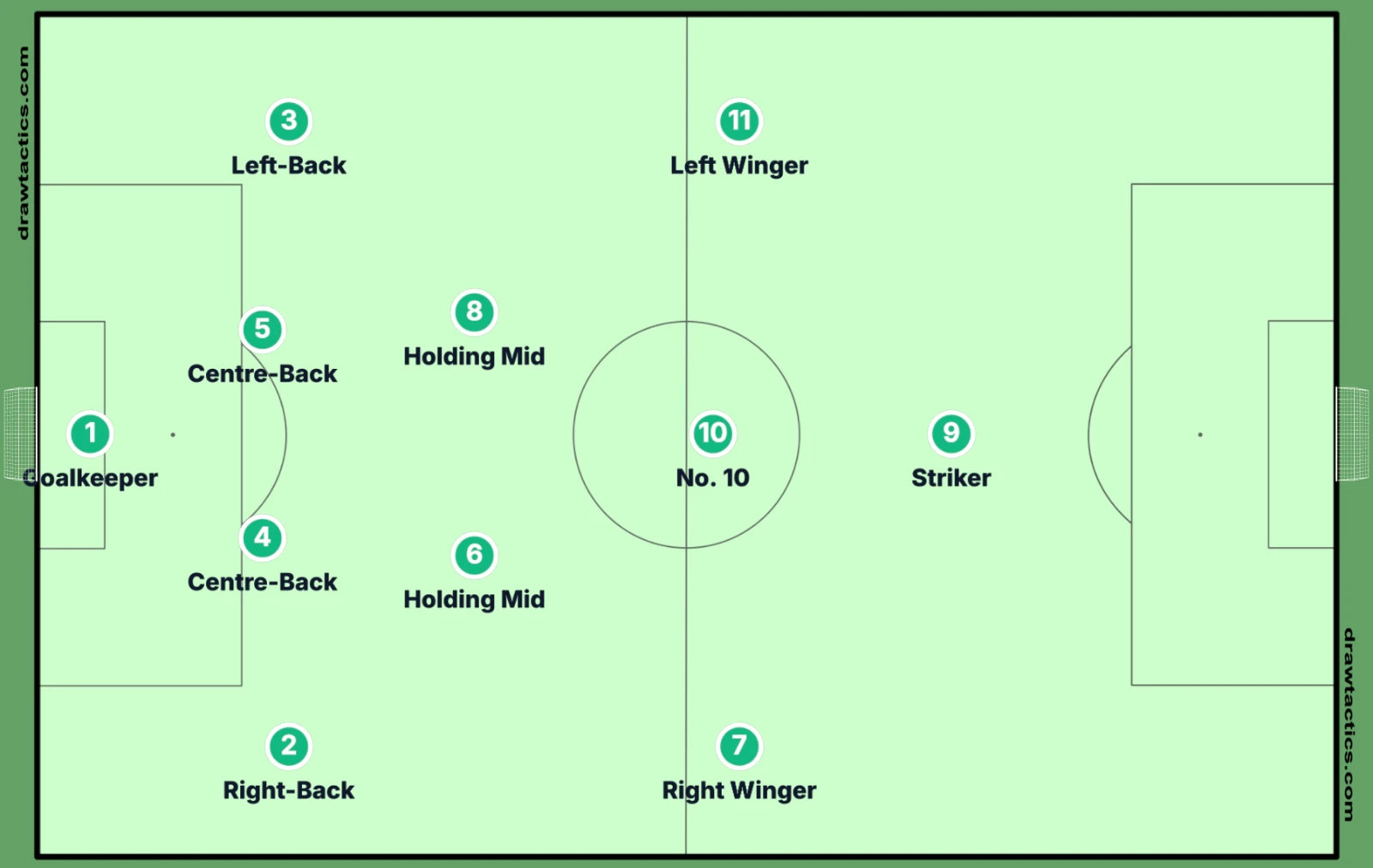
For most of the last twenty years, the 4-2-3-1 has been the shape you were most likely to see on a team sheet, from the Champions League down to Sunday league. It is not the most fashionable system any more, but it is still one of the most useful, because it gives every player a partner, keeps two midfielders in front of the back four, and still lets you attack with five or six players.
This guide explains how the 4-2-3-1 works in coaching terms: what each line does, how the double pivot builds and protects, how the shape turns into a 4-4-1-1 without the ball, where it is vulnerable, and how to train it.
In Short: Key Takeaways
- The double pivot is the system's base: two holding midfielders who protect the back four and start the build-up.
- The No. 10 lives between the opponent's midfield and defence, and is the first presser when the ball is lost.
- Without the ball the shape becomes a compact 4-4-1-1, with the wingers dropping into the midfield line.
- Its main risks are an isolated striker and a gap between the pivots and the No. 10.
Comparing shapes? Our soccer formations overview puts every major formation side by side, with diagrams and advice on choosing one.
Table of Contents
Why Coaches Choose the 4-2-3-1
Read the numbers from back to front: four defenders, two holding midfielders, three attacking midfielders and one striker. On paper it is a defensive shape with six players behind the ball. In practice the line of three is where the game is played, and the striker, the No. 10 and both wingers can all arrive in the box.
The appeal is balance without compromise. Your full-backs can push on because two midfielders are already screening the centre-backs. Your best creative player gets a central role with freedom. And when you lose the ball, the wingers only have a short distance to drop to make a flat midfield four.
It also maps neatly onto the way most squads are built. Most teams have two sensible central midfielders, one player who wants to play behind the striker, and two wide players who prefer to attack rather than track full-backs all game.
Where the 4-2-3-1 Came From
The shape grew out of the 4-4-2 in the 1990s, when coaches started pulling one striker back into the space between the opponent's midfield and defence, and pushing the wide midfielders higher. Spanish coaches were among the first to treat it as a system in its own right, and it spread quickly through Europe in the 2000s.
By the 2010 World Cup it was everywhere. Spain and Germany, the two most admired teams of that tournament, both lined up with two holding midfielders behind a band of three. José Mourinho's Inter won the Champions League the same year with a 4-2-3-1 that defended deep and broke quickly, which showed how differently the same numbers could be coached.
Since then many elite teams have moved towards 4-3-3 or back-three systems, but the 4-2-3-1 is still common in international football, in the middle of most leagues, and in youth and grassroots football where its clear partnerships are easy to teach.
Roles and Responsibilities
Back four
Centre-backs: they need to be comfortable receiving under some pressure and playing into the pivots, because the 4-2-3-1 usually builds through the middle first. Out of possession they defend the space behind a midfield that is often stepping forward to press.
Full-backs: they provide most of the width in the final third when the wingers come inside. That means one or both will be high in attack, so their recovery speed and their understanding with the nearest pivot matter more than their crossing.
The double pivot
The two holding midfielders, often called the 6 and the 8 in this system, are the heart of the 4-2-3-1. They are rarely identical. A common pairing is one controller who stays between the centre-backs and the No. 10 and dictates the tempo, and one runner who carries the ball, supports attacks and arrives late in the box. The non-negotiable rule is that they don't both leave at the same time.
The No. 10
The attacking midfielder operates in the pocket behind the opponent's midfield. In possession they receive on the half-turn, link with the striker, and make runs beyond when the 9 drops. Out of possession they are the first defender alongside the striker, usually tasked with keeping the opponent's holding midfielder quiet.
Wingers
Wingers in a 4-2-3-1 do two very different jobs. With the ball they either hold the touchline to stretch the back line or come inside to shoot and combine, depending on their stronger foot. Without it they drop in line with the pivots, so the work rate demand is high.
The striker
The lone 9 needs to occupy two centre-backs on their own. Some teams use a target striker who holds the ball up for the No. 10 and wingers; others use a runner who stretches the line and opens space in the pocket behind them. Either way, the striker has to set the press direction when the team loses the ball.
Building Up Through the Double Pivot
The 4-2-3-1's biggest advantage in build-up is the box formed by the two centre-backs and the two pivots. It gives the ball carrier a pass sideways and a pass forward at almost every moment, and it makes the team very hard to press through the middle.
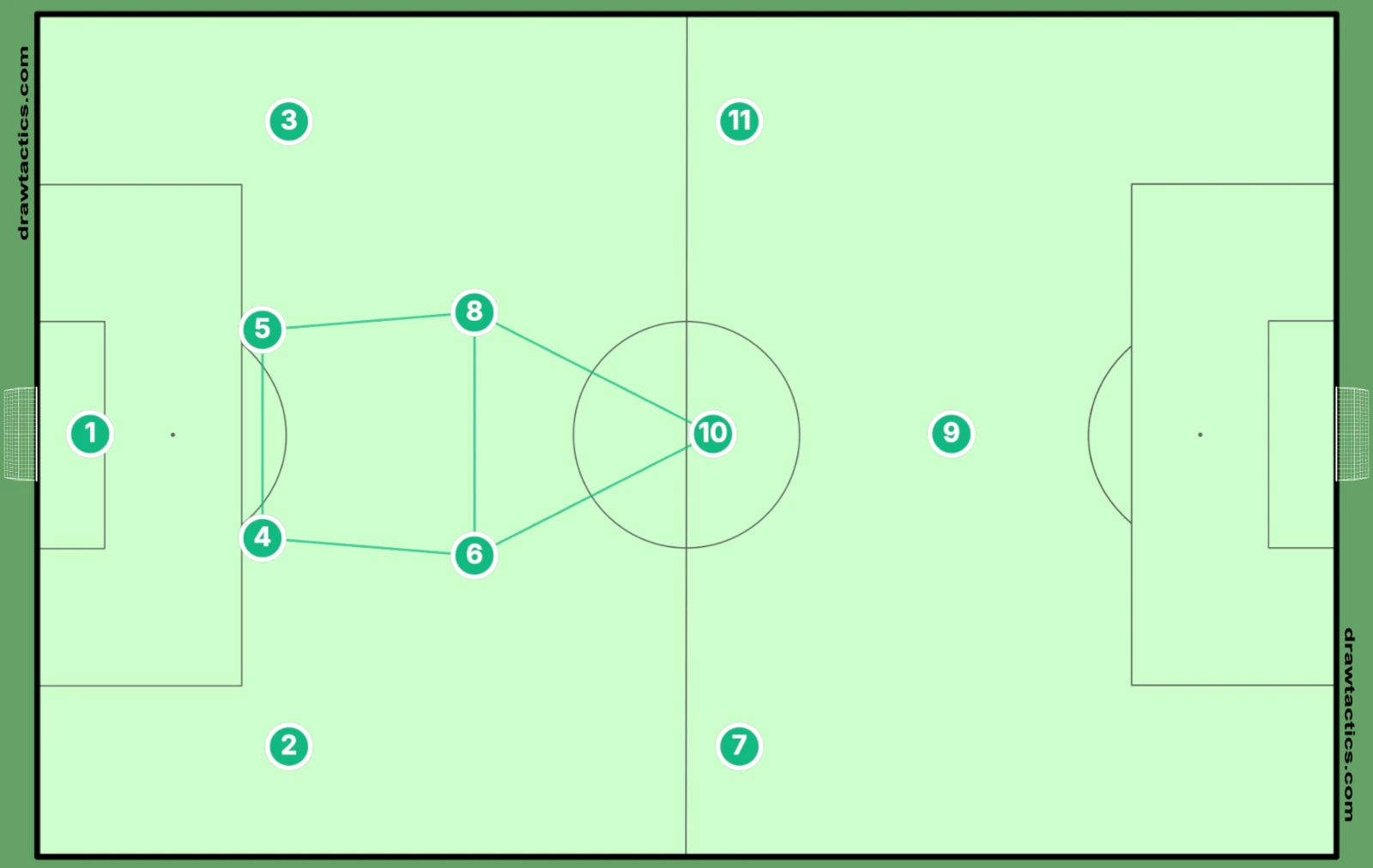
From there the next connection is the triangle between the two pivots and the No. 10. If the opponent presses with two forwards, one pivot can drop between or beside the centre-backs to make a back three, freeing the full-backs to push up. If the opponent sits off, both pivots can step up and play straight into the 10's feet.
The key coaching point is staggering. If the two pivots stand flat and side by side, one pass from the opponent can cut both of them out. Ask one to stand slightly higher than the other, so there is always a diagonal line between them.
Attacking Principles
Wingers inside, full-backs outside
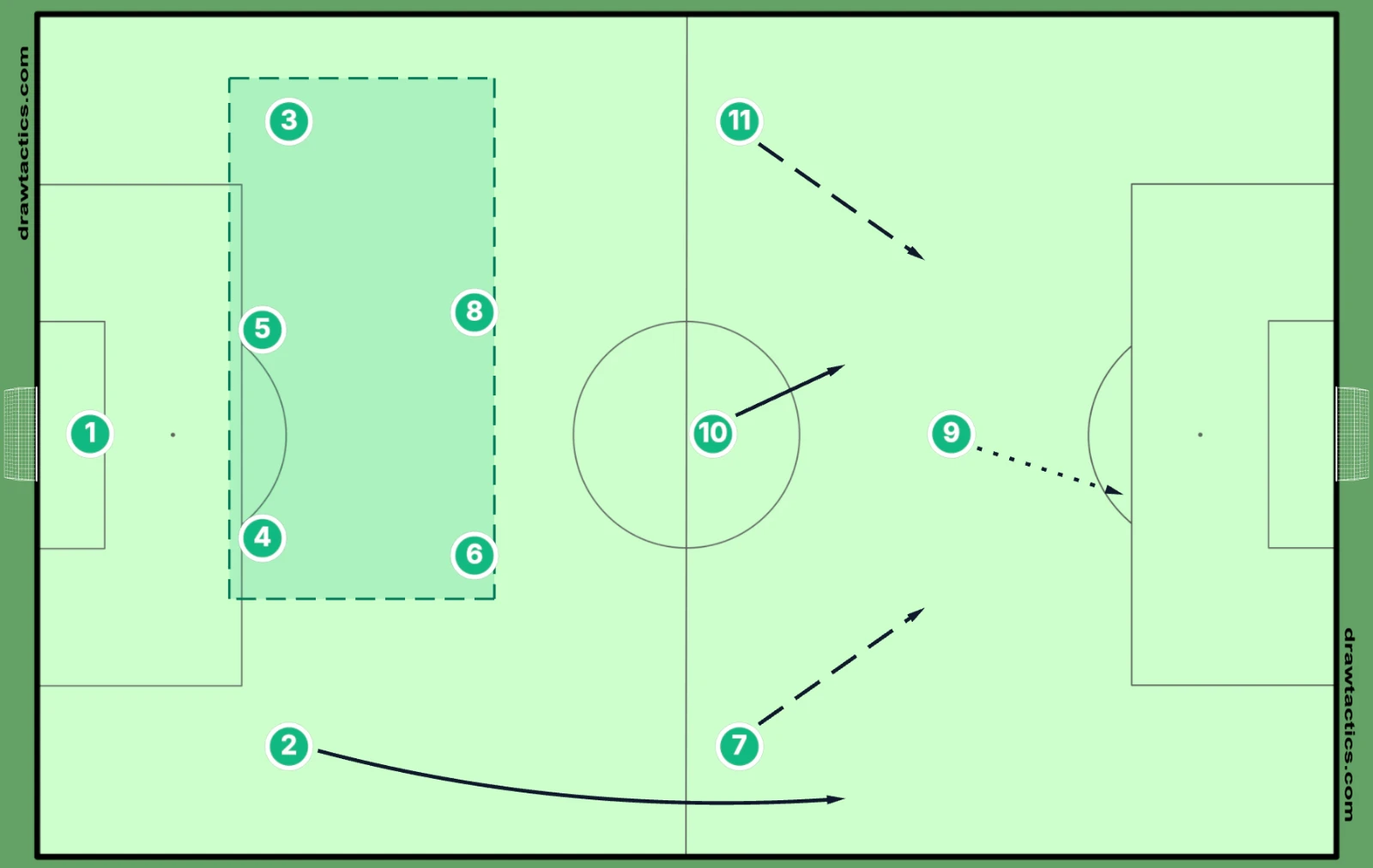
The most common attacking pattern in a modern 4-2-3-1 is the inverted winger. The right winger comes inside onto their left foot, which draws the opposing full-back with them and opens the touchline for the overlapping right-back. The same happens on the other side, or the far-side full-back stays home for balance.
The 10 and the 9 working together
The relationship between the No. 10 and the striker decides how dangerous the team is centrally. When the 9 drops to receive, the 10 runs beyond. When the 10 receives in the pocket, the 9 pins the centre-backs or runs across them. Rehearse these two movements until they happen without a call.
Common attacking patterns
- Overlap: the winger comes inside with the ball, the full-back runs round the outside to create a 2v1.
- Up-back-through: a pass into the 9's feet, a lay-off to the No. 10, and a through ball for a winger running in behind.
- Late arrival: the attacking pivot arrives at the edge of the box for cut-backs while the front four occupy the defenders.
- Switch: overload one side with winger, full-back and No. 10, then switch quickly to the far winger isolated against their full-back.
Defending: the 4-4-1-1 Block
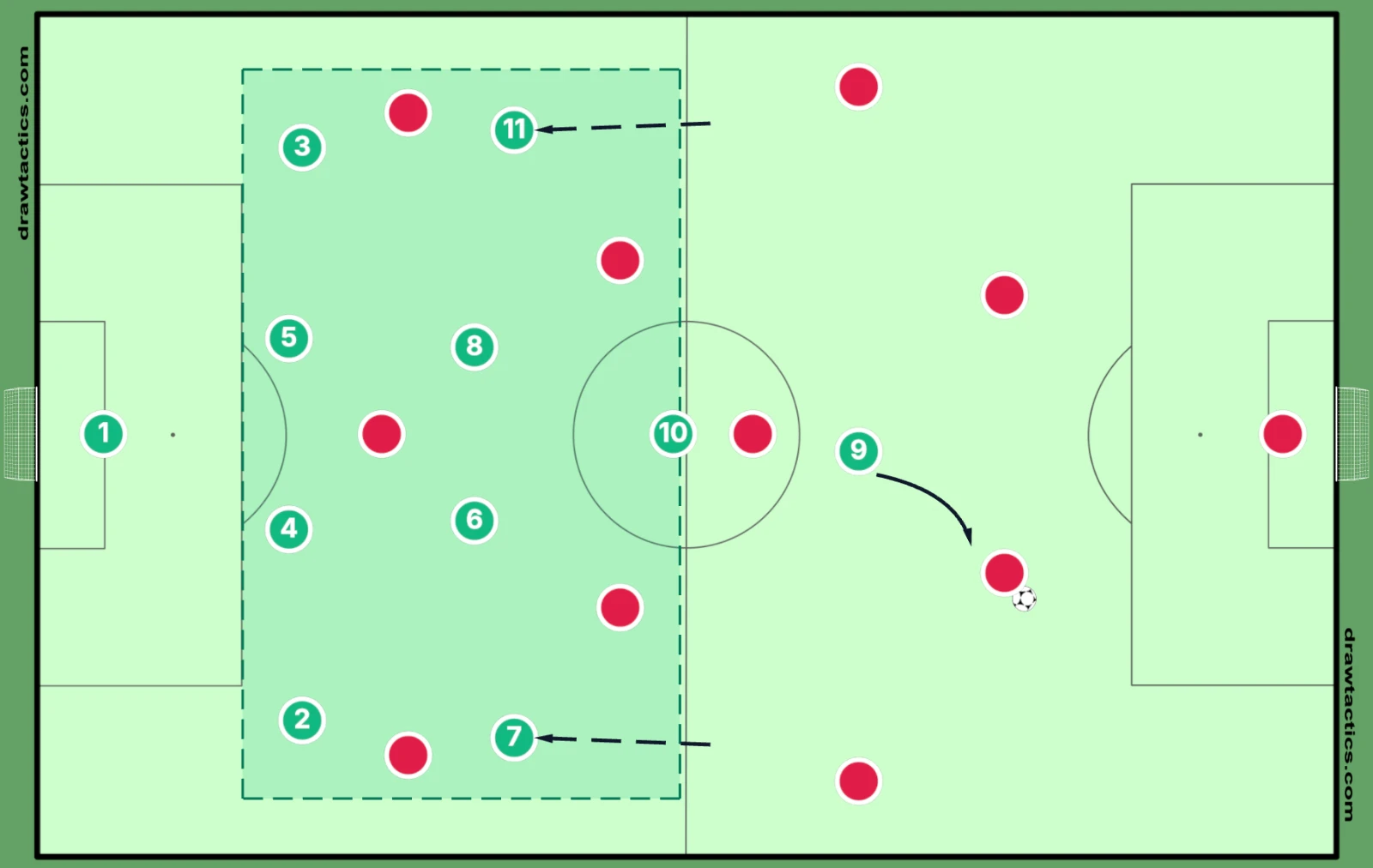
Without the ball the 4-2-3-1 changes shape more than most systems. The wingers drop level with the two pivots to form a flat midfield four, and the No. 10 steps up beside or just behind the striker. The result is a 4-4-1-1 or a 4-4-2, which is one of the most familiar and reliable defensive blocks in football.
Pressing triggers
A good way to press from a 4-4-1-1 is to let the 9 and 10 split the jobs. The striker curves their run onto the centre-back with the ball so the pass back across is blocked, while the No. 10 stays tight to the opponent's holding midfielder. Play is then pushed wide, where the winger and full-back can close the touchline together.
Agree a few clear triggers: a pass back to the goalkeeper, a bad touch, or a pass into a full-back facing their own goal. On those signals the whole block moves up together.
Rest defence
The 4-2-3-1 naturally gives you a strong rest defence because the pivots are already in position. The most common versions are a 2+2, with both centre-backs and both pivots holding while the full-backs attack, and a 3+2, with one full-back staying narrow next to the centre-backs. The 3+2 is the safer choice against teams with quick wingers.
Variations
4-4-1-1
The most conservative version keeps the wingers deeper and more disciplined, and uses the No. 10 as a second striker. It suits teams that defend in a mid or low block and attack on the counter.
4-2-3-1 into 4-3-3
Push one pivot higher and drop the No. 10 deeper, and the 4-2-3-1 becomes a 4-3-3 with two 8s. Many teams switch between the two during a match: double pivot to build, single pivot once they are established in the opponent's half.
2-3-5 in possession
Possession teams often push both full-backs high, drop one pivot into midfield alone, and send both wingers and the No. 10 forward with the striker. This gives five attackers across the front, but it relies on the centre-backs and one pivot to cover counters.
False 9
Replacing the striker with a player who drops off gives you two No. 10s in the pocket. It suits teams with technical forwards and quick wingers who can attack the space the 9 leaves behind.
4-2-3-1 vs Other Systems
4-2-3-1 vs 4-4-2
Against a 4-4-2, the No. 10 is the key. They stand between two flat lines where nobody is naturally responsible for them, and the double pivot gives you 3v2 in central midfield when they drop. The 4-4-2's answer is usually to drop a striker onto your pivot.
4-2-3-1 vs 4-3-3
Against a 4-3-3 the midfields match up almost player for player: your pivots meet their 8s, and your 10 meets their 6. Games are decided by who wins those individual duels and by which full-backs get forward first.
4-2-3-1 vs back three
Against a 3-5-2 or 3-4-3, the lone striker is outnumbered by three centre-backs and the wing-backs can pin your wingers back. Teams often respond by pushing the wingers high to press the wide centre-backs, or by switching to a two-striker shape.
Weaknesses and Fixes
- Isolated striker: if the 10 and wingers are too deep, the 9 fights two centre-backs alone. Set a rule that at least one attacker joins the striker within a few seconds of winning the ball.
- Gap behind the 10: if the pivots sit too deep, the opponent plays through the space between them and the No. 10. Keep the distance between the lines short, both with and without the ball.
- Exposed full-backs: when both full-backs attack and the wingers stay high, counters down the sides are dangerous. Decide in advance which full-back stays.
- Tired wingers: the defensive running demanded of wide players is high. Plan substitutions for those positions, or use the 4-4-1-1 version when the team needs a rest.
Most problems in a 4-2-3-1 come from distances, not from the formation itself. If the team stays compact, it is hard to play through; if it stretches, every weakness above appears at once.
Coaching the 4-2-3-1
Personnel priorities
- Centre-backs who can pass into midfield under pressure.
- Two pivots who complement each other: one controller, one runner.
- A No. 10 who can receive on the half-turn and press from the front.
- Wingers who can beat a full-back and still track back.
- Full-backs with the recovery pace to cover the space they leave.
- A striker who fits your way of attacking: a reference point or a runner.
Training focus areas
- Build-up through the box: centre-backs and pivots against two or three pressers.
- Receiving in the pocket: the 10 and inside wingers against a midfield line.
- The switch from 4-2-3-1 to 4-4-1-1 the moment the ball is lost.
- Rest-defence rules: who stays, and where, in every attacking phase.
Build these themes into a full session in the free football session planner: warm-up, main practice and game, each with a drill diagram and coaching points, ready to print as a PDF.
With younger players, start with the pressing ideas in our guide to teaching pressing to youth players before asking the 9 and 10 to coordinate the 4-4-1-1 press.
Drawing the 4-2-3-1 with DrawTactics
The 4-2-3-1 changes shape between phases, so a single static picture is rarely enough. With the DrawTactics football tactics board you can lay out the shape, show the box in build-up, and animate the wingers dropping into the 4-4-1-1 so players see both shapes and the movement between them.
All the diagrams in this article were made on the board. If you only need to share your starting XI, the free football lineup builder makes a team sheet in seconds.
Plan Your 4-2-3-1
Set up your shape, map the double pivot and the press, and share clear tactical diagrams with your players.
Start with DrawTacticsConclusion
The 4-2-3-1 has lasted because it gives coaches security and creativity in the same shape. The double pivot protects the back four and starts every attack, the No. 10 and wingers give the team quality between the lines, and the switch to a 4-4-1-1 block is simple to teach.
Get the distances right, decide your rest defence before the game, and make sure the striker never feels alone, and the 4-2-3-1 will work at almost any level.
FAQ
Is the 4-2-3-1 a defensive or an attacking formation?
Both, depending on how you coach it. The double pivot and back four give it a solid base, while the No. 10, two wingers and overlapping full-backs give it five or six attackers in possession. Sitting the pivots deep makes it cautious; pushing one pivot forward makes it aggressive.
What is the difference between a 4-2-3-1 and a 4-3-3?
The midfield triangle points the other way. A 4-2-3-1 has two holding midfielders and one No. 10, while a classic 4-3-3 has one holding midfielder and two No. 8s. The 4-2-3-1 is safer in front of the back four; the 4-3-3 puts more bodies between the lines.
How does a 4-2-3-1 defend?
Usually as a 4-4-1-1 or 4-4-2. The wingers drop level with the two pivots to make a midfield four, and the No. 10 steps up beside or just behind the striker to block passes into the opponent's holding midfielder.
Is the 4-2-3-1 good for youth football?
Yes. Every player has a clear partner and a clear zone, which makes it easy to teach. Keep the two pivots' jobs simple at first: one steps, one covers.