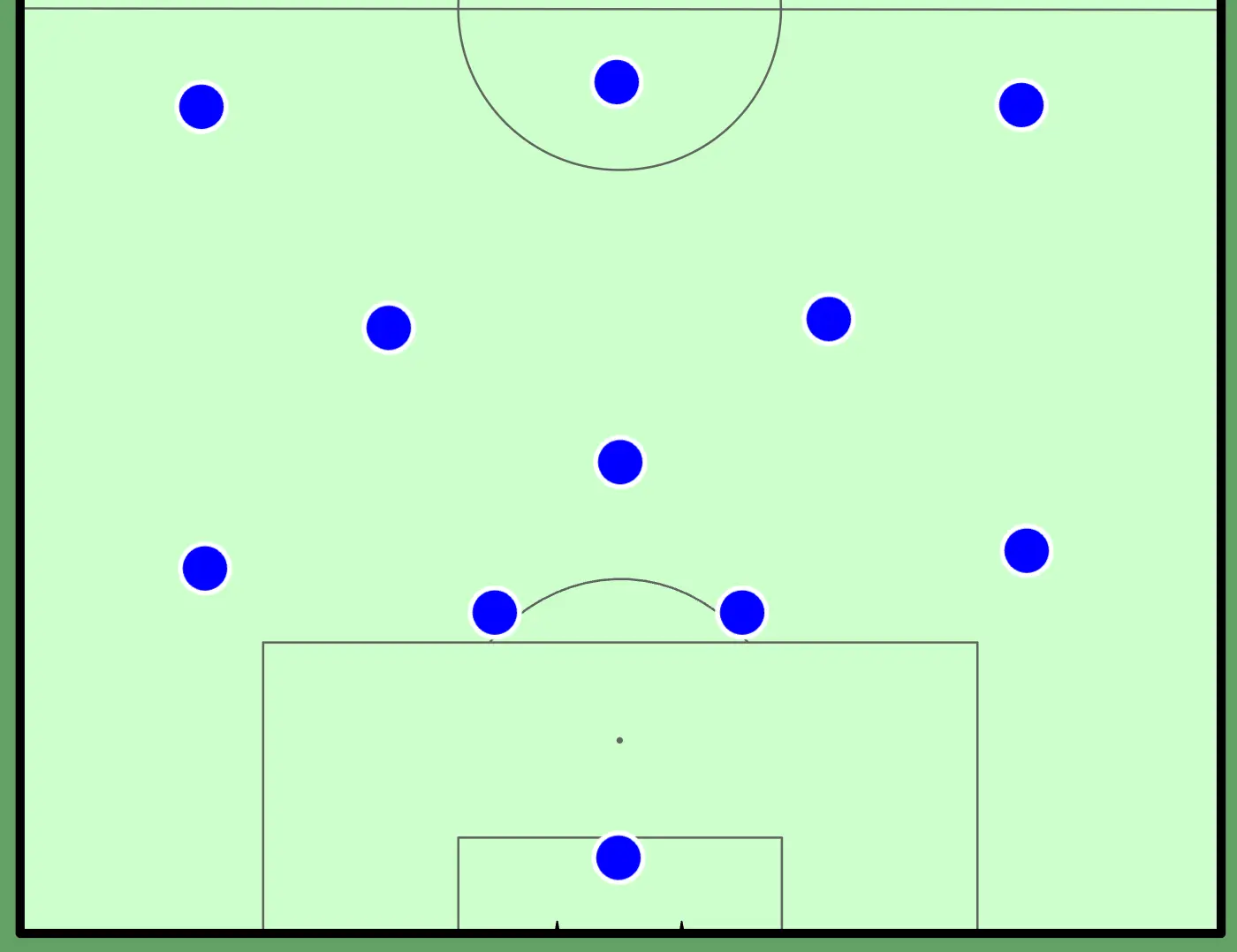
The 4-3-3 has shaped modern football for more than six decades. From Brazil's 1962 adaptation to Guardiola's positional play and Klopp's pressing structures, it remains one of the most reliable frameworks for balancing control and attacking threat.
This guide explains the system in practical coaching terms: structure, role demands, pressing logic, transition protection, and how to adapt the model to different squad profiles.
In Short: Key Takeaways
- The 4-3-3 combines central control, width, and pressing efficiency.
- The single pivot and two 8s define midfield balance and progression quality.
- Full-back behavior is a major lever in both chance creation and transition risk.
- Rest-defense structure decides whether the system survives counter-attacks.
Table of Contents
Why the 4-3-3 Dominates Modern Football
The 4-3-3 distributes ten outfield players across three clear lines: four defenders, three midfielders, and three attackers. This naturally creates passing triangles, supports high pressing, and keeps width high in attack.
Its biggest advantage is balance. Compared with 4-4-2 structures, it protects central spaces better. Compared with 4-2-3-1, it often gives clearer role hierarchy in pressing and transition phases. Coaches can shift from high press to compact block to controlled possession without changing the entire shape.
Historical Development of the 4-3-3
Brazil 1962
The 1962 World Cup was a defining tactical moment. Brazil moved from a 4-2-4 toward a three-man midfield by repositioning Mário Zagallo deeper. That central 3v2 advantage gave better control and became a tactical reference for coaches globally.
Dutch Total Football
Rinus Michels and Johan Cruyff expanded the system through positional fluidity and rational occupation of space. Later, Cruyff and Van Gaal reinforced these principles at Barcelona, where the 4-3-3 became institutional from first team to academy levels.
Structural Breakdown: Roles and Responsibilities
Back Four
Center-backs: modern 4-3-3 center-backs must initiate build-up under pressure and maintain cover when full-backs advance.
Full-backs: they are both width providers and transition defenders. Depending on model, they overlap outside or invert into midfield in first phase.
Midfield Three
The 6: screens the defense, organizes tempo, and often supports build-up by dropping between or alongside center-backs.
The 8s: connect phases, occupy half-spaces, and provide late-box presence. Their timing determines how dangerous the system becomes between lines.
Front Three
Wingers: they can stay wide to stretch lines or invert for shooting and combination play.
The 9: can be a fixed reference or a false-nine profile dropping to create overloads and draw center-backs out of line.
Offensive Principles: Creating Advantages
Triangles and Diamonds
The 4-3-3 naturally forms triangles at each line. With a ball-playing goalkeeper involved, these become diamonds that increase first-phase security and improve press resistance.
Overloads and Half-Spaces
The shape is excellent for overloading central corridors and half-spaces. Rotations between full-back, 8, and winger can unbalance marking lines and open vertical passing lanes.
Common Attacking Patterns
- Overlap: full-back goes outside winger to create 2v1.
- Third-man run: pass into support player, then release a runner from midfield.
- Switch of play: overload one side, then quickly find the isolated far winger.
Defensive Organization: Pressing and Recovery
High Press Structure
The front three can direct build-up to one side. The 9 screens central access, the near winger jumps to full-back, and the midfield line supports the lock. This makes the 4-3-3 one of the most practical pressing systems in elite football.
Recovery Shapes
When the high press is bypassed, teams often recover into 4-1-4-1 or a deeper 4-5-1. These structures preserve central compactness while still allowing winger-led counters.
Rest Defense
Transition control is crucial. Two common models:
- 2-3 rest defense: two center-backs plus a three-player line ahead.
- 3-2 rest defense: one full-back stays with center-backs; two players screen ahead.
Choosing the right rest-defense model depends on opponent transition profile and your full-back behavior.
Modern Variations and Evolutions
Box Midfields
Inverted full-backs can create central boxes in possession, increasing control and improving connection to advanced lines.
Center-Back Progression
Many teams now use progressive carries from center-backs to trigger midfield pressure and open passing lanes.
Specialist Pivot Profiles
The modern 6 combines defensive awareness with playmaking and final-third timing, not just screening and short recycling.
4-3-3 vs Alternative Formations
4-3-3 vs 4-4-2
The 4-3-3 usually wins central numbers through 3v2 midfield control, while 4-4-2 offers directness and two-striker occupation.
4-3-3 vs 4-2-3-1
The single-pivot 4-3-3 often supports proactive pressing and cleaner half-space occupation. The 4-2-3-1 may offer more immediate defensive stability via double pivot support.
4-3-3 vs Back-Three Systems
Back-three opponents can match or exceed central numbers. The 4-3-3 answer is often dynamic winger positioning, sharper switches, and disciplined rest defense to avoid transition traps.
Tactical Vulnerabilities and Solutions
- Wide transition exposure: manage full-back height and rest-defense spacing.
- High physical demand: winger and 8 workloads must be managed.
- Isolated 9: require synchronized support from wingers and 8s.
Most problems in 4-3-3 come from distance management, not formation labels. If vertical and horizontal compactness are lost, any version becomes unstable.
Implementing the 4-3-3: Practical Recommendations
Personnel Priorities
- Comfortable build-up center-backs.
- Two-way full-backs who can overlap or invert.
- A positionally disciplined 6 with passing range.
- 8s with stamina, timing, and half-space awareness.
- Wingers with both attacking threat and defensive discipline.
- A 9 profile that fits your progression model.
Training Focus Areas
- Positional rotations and triangle maintenance.
- Pressing trigger coordination between front and midfield lines.
- Rest-defense rehearsal during attacking possession.
- Half-space reception patterns for 8s and inverted wingers.
When introducing those behaviours to younger teams, use the progression in our guide to teaching pressing to youth players before adding the full 4-3-3 unit structure.
Adapting to Squad Reality
If technical quality is limited, simplify progression and increase direct options. If full-backs cannot sustain repeated high-intensity runs, keep a more compact width strategy and use wingers to hold touchline roles.
Visualising the 4-3-3 with DrawTactics
Coaches need to communicate spacing, rotations, and transition rules clearly. DrawTactics helps build and animate 4-3-3 structures with a practical digital football tactics board.
Use it to map line relationships, rehearse third-man combinations, and present role-specific detail to players and staff.
Just need to share your 4-3-3 starting XI? Make a team sheet in seconds with the free football lineup builder.
Build Your 4-3-3 Workflow
Design your structure, map attacking patterns, and prepare clear tactical communication for your team.
Start with DrawTacticsConclusion
The 4-3-3 has stayed relevant because it offers a rare tactical combination: strong central control, reliable width, and scalable pressing behavior. It is both structured and adaptable.
When role clarity, training repetition, and transition discipline are aligned, the 4-3-3 becomes one of the most robust systems available to coaches at every level.
FAQ
What is the most important position in a 4-3-3?
The 6 is often the structural anchor, but system success depends on the combined behavior of full-backs, 8s, and wingers around that pivot.
How do you stop counters in a 4-3-3?
Use clear rest-defense roles and avoid advancing both full-backs without cover. Distances between lines are critical.
Can a defensive team still use 4-3-3?
Yes. It can be coached in a more conservative 4-1-4-1/4-5-1 recovery model while preserving transition attacking options.