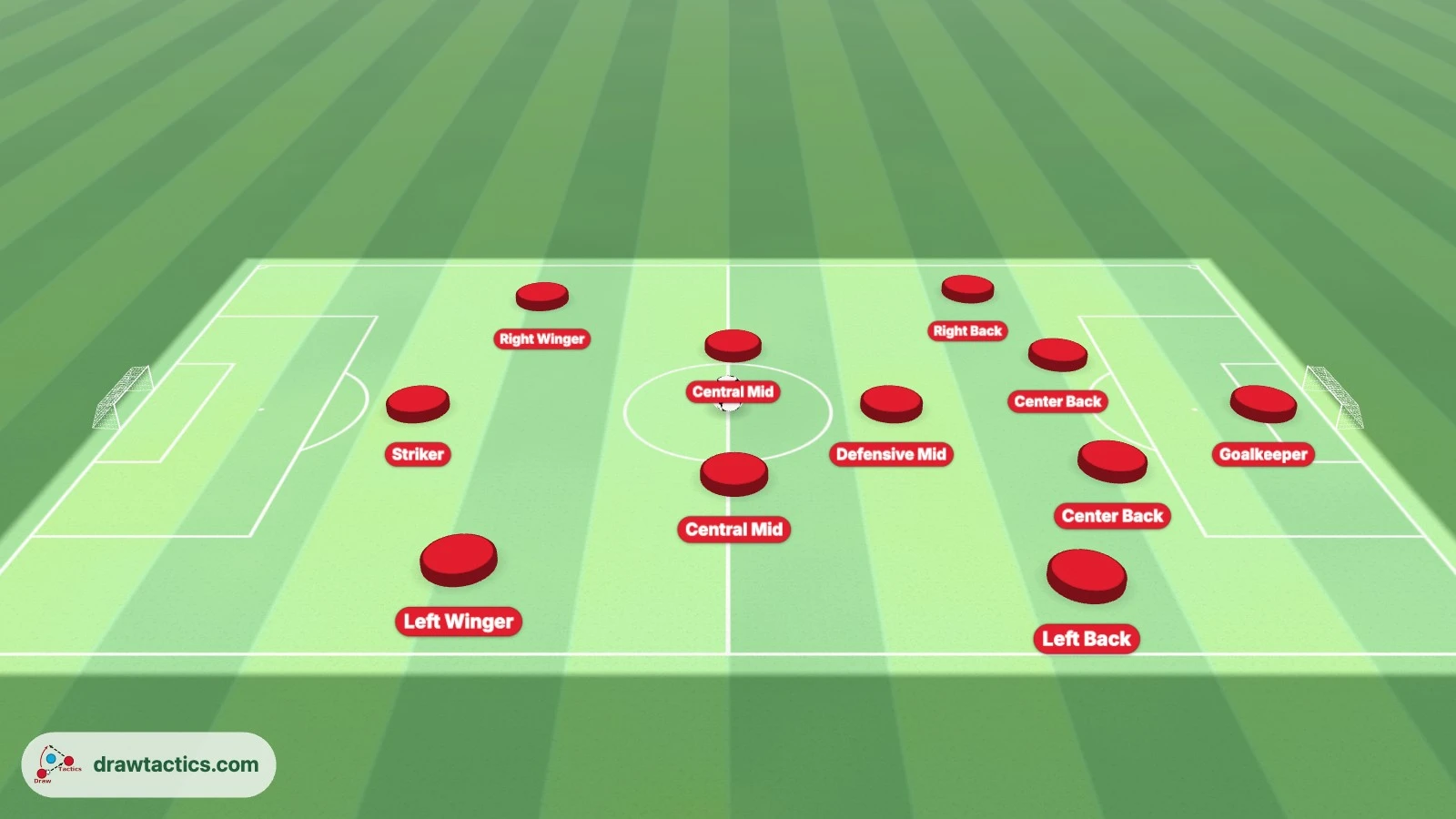
A soccer team has eleven players on the field, and every one of them has a position with a name, a number and a job. This guide explains all of the soccer positions: what each one does, the skills it needs, the abbreviations you'll see on lineups and in video games, and the traditional position numbers from 1 to 11.
It's written for coaches, parents and players who want a clear picture of who does what, with diagrams of where each position stands on the field.
In Short: Key Takeaways
- Soccer has four position groups: goalkeeper, defenders, midfielders and forwards.
- Within them sit about a dozen common positions, from center-back and full-back to defensive midfielder, winger and striker.
- The traditional numbers run 1 (goalkeeper) to 11 (left winger), and coaches still use them as shorthand for roles: "a 6", "a 10", "a 9".
- Which positions a team uses depends on its formation, so the same player can have a different job from one system to the next.
Table of Contents
- How Many Positions Are There in Soccer?
- The Four Position Groups
- Goalkeeper
- Defenders: Center-Back, Full-Back, Wing-Back
- Midfielders: Defensive, Central, Attacking, Wide
- Forwards: Winger, Striker, Second Striker
- Soccer Position Numbers
- Soccer Position Abbreviations
- Positions in Different Formations
- Which Position Is Best for a Player?
- Positions in Youth and Small-Sided Soccer
- FAQ
How Many Positions Are There in Soccer?
Each team has eleven players on the field: one goalkeeper and ten outfield players. There's no fixed list of positions in the Laws of the Game, so the exact number depends on how finely you split them, but most coaches work with around a dozen named positions in four groups.
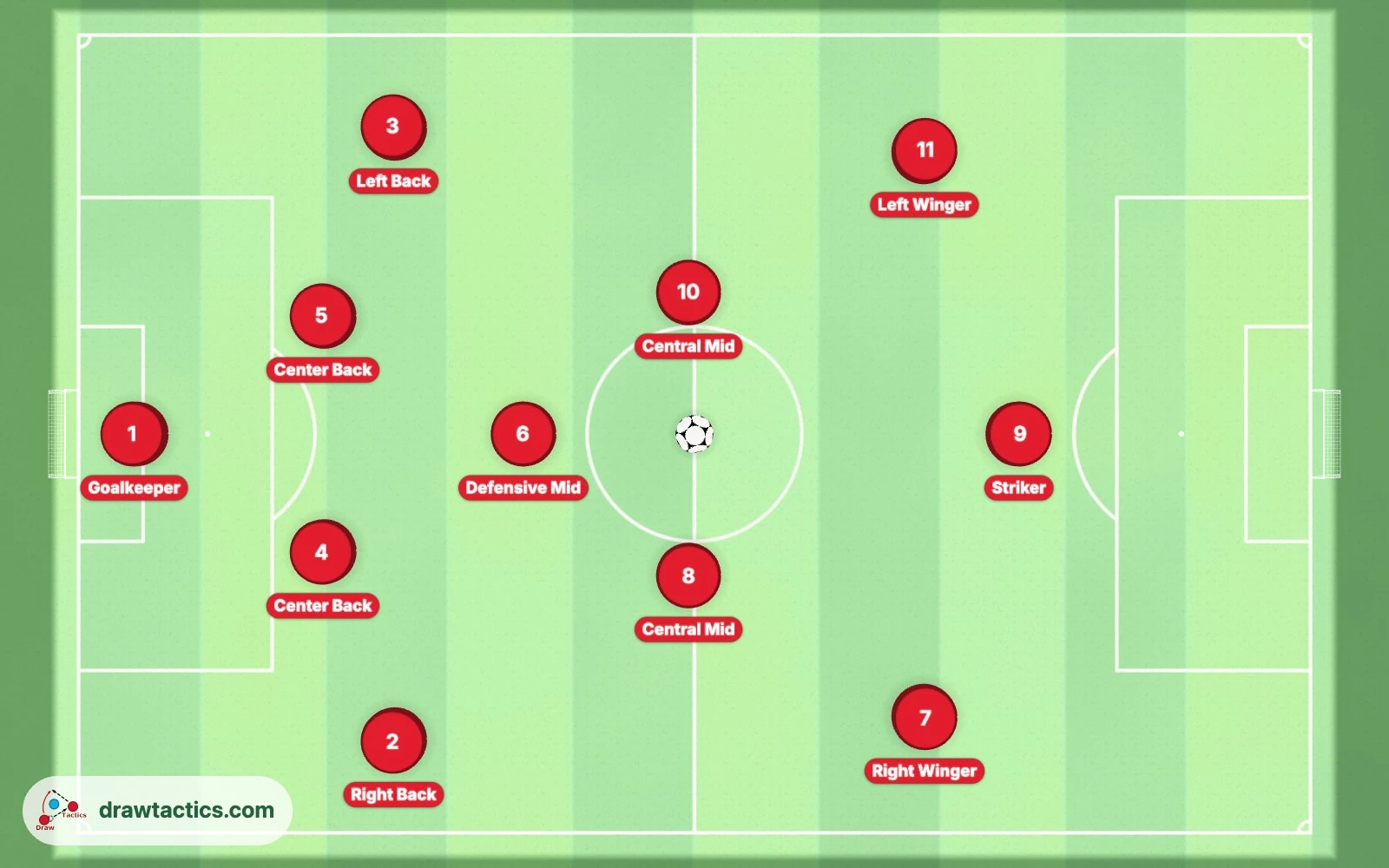
The diagram above shows a common 4-3-3. Notice that "right" and "left" are always from the team's own point of view as it attacks: the right back plays on the right-hand side when facing the opponent's goal.
The Four Position Groups
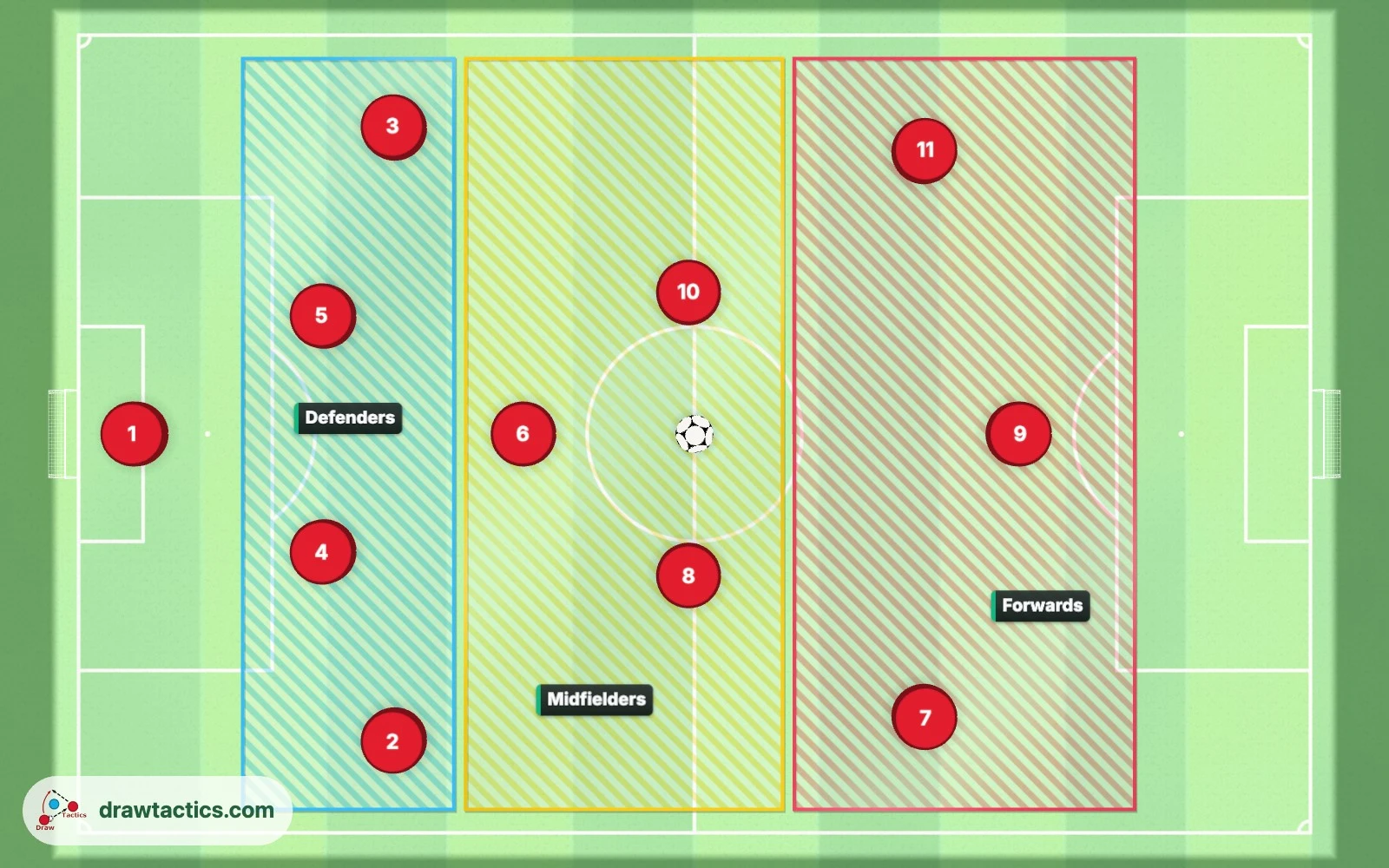
- Goalkeeper: the only player allowed to handle the ball, inside their own penalty area.
- Defenders: the back line, whose first job is to stop the opponent scoring.
- Midfielders: the link between defense and attack, involved in almost every phase of play.
- Forwards: the players closest to the opponent's goal, whose main job is to create and score chances.
Formation numbers describe these lines from back to front. A 4-3-3 means four defenders, three midfielders and three forwards. Our soccer formations guide explains every major shape.
Goalkeeper (GK)
The goalkeeper guards the goal and is the last line of defense. Inside their own penalty area they can use their hands, which makes them the only player who can catch the ball in open play.
What they do: stop shots, claim crosses, organize the defense in front of them, and restart play with throws, kicks and goal kicks. In the modern game goalkeepers are also expected to pass out from the back, often acting as an extra defender when their team has the ball.
Key skills: handling, reflexes, positioning, decision-making on crosses, communication, and increasingly, passing with both feet.
Defenders
Center-back (CB)
Center-backs play in the middle of the defensive line, directly in front of the goalkeeper. Most teams use two, and back-three systems use three.
What they do: mark the opposing striker, win headers, block shots, and keep the back line organized and at the right height. With the ball, they start attacks with passes into midfield or forward runs with the ball.
Key skills: heading, tackling, reading the game, strength, and composure on the ball. You'll also hear about variations such as the ball-playing center-back, comfortable passing through the lines, and the sweeper (or libero), a free defender who covers behind the others; the sweeper is rare in modern 11v11 soccer but still common in youth formats.
Full-back (RB and LB)
The right back and left back play on the outside of a back four, between the center-backs and the touchline.
What they do: defend against the opponent's wingers, then support attacks by running past their own winger on the outside (an overlap) or by moving inside into midfield (an inverted full-back).
Key skills: one-on-one defending, speed, stamina, crossing, and the judgment to know when to go forward and when to stay home.
Wing-back (RWB and LWB)
Wing-backs are the wide players in a back three or back five. Unlike full-backs, they have no winger in front of them, so each wing-back covers the whole flank on their own.
What they do: provide the team's width in attack, often as high as the forwards, then sprint back to make a back five when the team defends.
Key skills: exceptional stamina, pace, crossing and defensive discipline. It's one of the most physically demanding positions on the field. The 3-5-2 guide explains how wing-backs work in detail.
Midfielders
Defensive midfielder (CDM, the "6")
The defensive midfielder plays in front of the back line. You'll also hear the role called the holding midfielder, the anchor, the pivot or simply "the 6".
What they do: screen the defense by blocking passes into the strikers, win the ball back, and keep possession ticking over with simple, reliable passes. Some defensive midfielders are mainly ball-winners; others, sometimes called a regista or deep-lying playmaker, set the team's tempo with their passing.
Key skills: positioning, tackling and interceptions, awareness of space, and calm passing under pressure. Teams with two defensive midfielders side by side use a double pivot, as in the 4-2-3-1.
Central midfielder (CM, the "8")
Central midfielders play in the middle of the field and connect defense to attack. The classic version is the box-to-box midfielder, who helps defend at one end and arrives to shoot at the other.
What they do: receive from the defenders, carry and pass the ball forward, support attacks with late runs into the box, and press and recover when the ball is lost.
Key skills: stamina, passing range, receiving on the half-turn, and good timing for runs. In a 4-3-3 the two central midfielders are often called the "8s" and play in the half-spaces, the channels between the center and the wings.
Attacking midfielder (CAM, the "10")
The attacking midfielder plays behind the striker, in the space between the opponent's midfield and defense. The role is often called the No. 10 or the playmaker.
What they do: find space between the lines, turn, and play the final pass or take the shot. Without the ball, they are usually the first player to press the opponent's defensive midfielder.
Key skills: vision, close control, creativity, quick decision-making and shooting from distance.
Wide midfielder (RM and LM)
Wide midfielders play on the flanks of a midfield four, as in the 4-4-2. They sit a little deeper than wingers and do more defending.
What they do: track the opposing full-back, help their own full-back defend, and supply crosses and runs in attack.
Key skills: work rate, crossing, one-on-one ability and discipline in holding the team's shape.
Forwards
Winger (RW and LW)
Wingers play high and wide in a front three, as in the 4-3-3.
What they do: stretch the opponent's defense, beat defenders one on one, and create chances with crosses or cut-backs. An inverted winger plays on the opposite side to their stronger foot (a left-footer on the right, for example), so they can cut inside and shoot.
Key skills: pace, dribbling, crossing, finishing, and the work rate to help defend.
Striker (ST or CF, the "9")
The striker, or center forward, is the team's most advanced player and its main goal threat.
What they do: score goals, hold the ball up so teammates can join the attack, run in behind the defense, and lead the press when the team loses the ball. Common types include the target forward, strong in the air and good with their back to goal; the poacher, who lives in the penalty area; and the false 9, who drops into midfield to pull center-backs out of position.
Key skills: finishing with both feet and the head, movement, hold-up play and composure in front of goal.
Second striker (SS)
The second striker plays just behind or alongside the main striker, somewhere between a No. 10 and a No. 9. It's most common in two-striker systems.
What they do: link midfield to the striker, drop into space to receive, and arrive in the box for rebounds and cut-backs.
Soccer Position Numbers
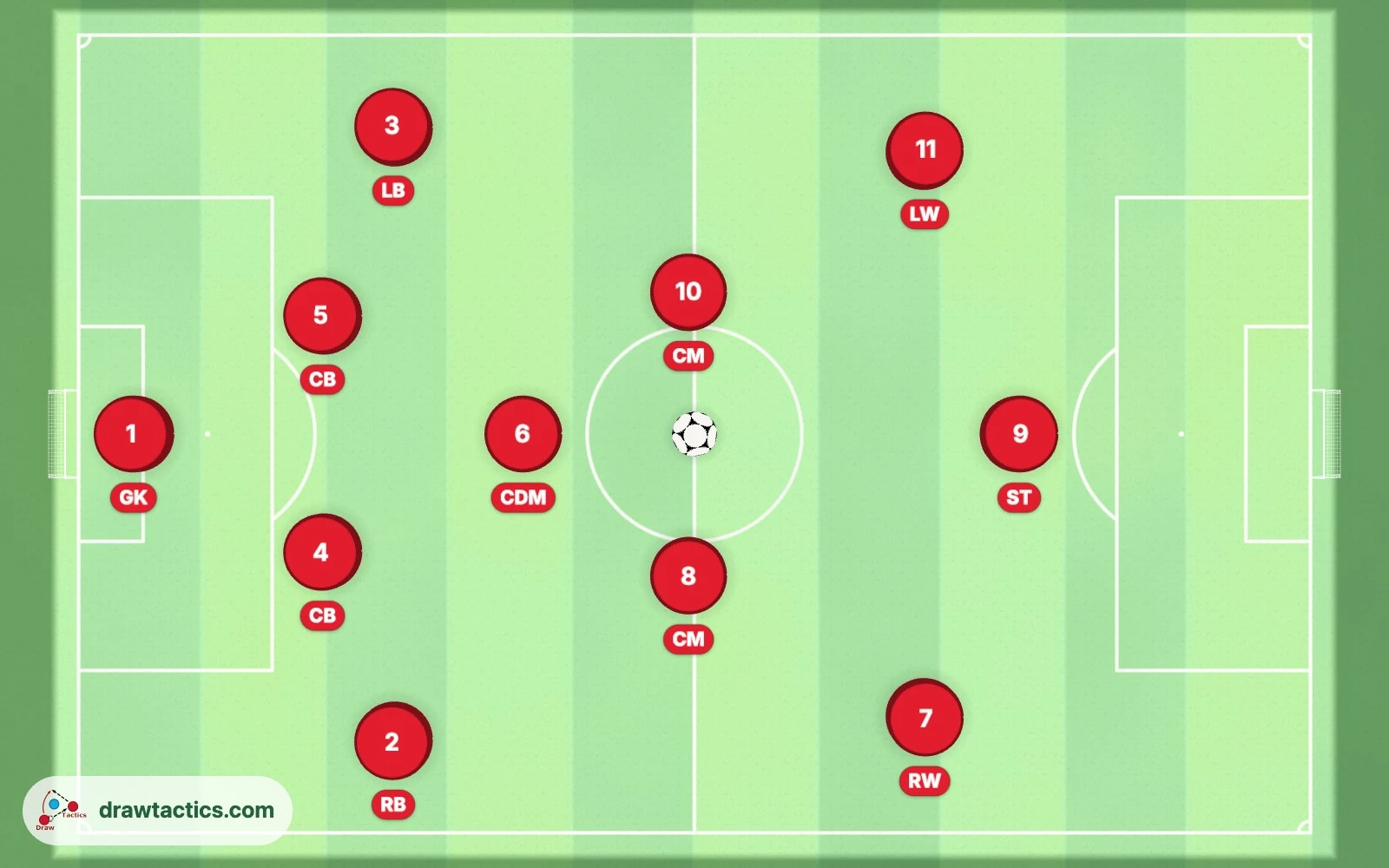
Before squad numbers became fixed to players, shirts were numbered 1 to 11 by position. Those numbers stuck as shorthand: coaches still talk about "a 6" or "a classic 10" when they mean a type of player. The most common system today, based on the 4-3-3, looks like this:
| Number | Position | Also called |
|---|---|---|
| 1 | Goalkeeper | Keeper, GK |
| 2 | Right back | Right full-back |
| 3 | Left back | Left full-back |
| 4 | Center-back | Sometimes the defensive midfielder |
| 5 | Center-back | Stopper |
| 6 | Defensive midfielder | Holding midfielder, anchor, pivot |
| 7 | Right winger | Right midfielder |
| 8 | Central midfielder | Box-to-box midfielder |
| 9 | Striker | Center forward |
| 10 | Attacking midfielder | Playmaker, second striker |
| 11 | Left winger | Left midfielder |
The system isn't universal. In Brazil the 3 and 4 are traditionally the center-backs, the 6 is the left back and the 5 is the defensive midfielder (the volante). In Argentina the 2 and 6 are center-backs, the 4 is the right back and the 5 is the central defensive midfielder. In professional soccer today players keep the same number all season whatever position they play, so numbers like 14, 23 or 99 tell you nothing about the role.
Soccer Position Abbreviations
Lineups, scouting reports and video games use short codes for each position. These are the ones you'll see most often:
| Abbreviation | Position | Group |
|---|---|---|
| GK | Goalkeeper | Goalkeeper |
| CB | Center-back | Defender |
| RB / LB | Right / left back | Defender |
| RWB / LWB | Right / left wing-back | Defender |
| SW | Sweeper | Defender |
| CDM / DM | Central defensive midfielder | Midfielder |
| CM | Central midfielder | Midfielder |
| CAM / AM | Central attacking midfielder | Midfielder |
| RM / LM | Right / left midfielder | Midfielder |
| RW / LW | Right / left winger | Forward |
| CF | Center forward | Forward |
| ST | Striker | Forward |
| SS | Second striker | Forward |
Positions in Different Formations
A team's formation decides which of these positions it uses. A 4-4-2 has wide midfielders and two strikers but no wingers or No. 10. A 4-3-3 has a defensive midfielder, two central midfielders and two wingers. A 3-5-2 swaps full-backs for wing-backs and adds a third center-back.
- 4-4-2: two center-backs, two full-backs, two central and two wide midfielders, two strikers.
- 4-3-3: a back four, a defensive midfielder, two central midfielders, two wingers and a striker.
- 4-2-3-1: a back four, two defensive midfielders, a No. 10, two wide players and a striker.
- 3-5-2: three center-backs, two wing-backs, three central midfielders and two strikers.
Positions also change during a game. A winger in a 4-3-3 often drops back to become a wide midfielder when the team defends, and a full-back may step into midfield when it attacks. See the soccer formations guide for diagrams of every major shape.
Which Position Is Best for a Player?
There's no best position in soccer, only the one that suits a player's strengths. A few rough guides:
- Brave, good with their hands and a strong communicator: goalkeeper.
- Strong in the air, good at reading danger and calm under pressure: center-back.
- Fast, tireless and happy to defend and attack: full-back or wing-back.
- Always wants the ball, sees passes others don't: central or attacking midfielder.
- Loves to dribble and take players on: winger.
- Lives for scoring goals: striker.
For young players, it's better not to settle on one position too early. Playing in different positions teaches players what their teammates need from them, and many professionals started their careers in a different role from the one they're known for.
Positions in Youth and Small-Sided Soccer
Youth soccer is usually played with fewer players, so teams use fewer positions. A 7v7 team might play a 2-3-1, with two defenders, three midfielders and one forward. Each of these guides shows the common formations for its format, with a free lineup maker:
Planning Positions With DrawTactics
Once you know the positions, the next step is deciding who plays where. The free soccer lineup builder lets you pick a formation, add your players to each position and download the lineup as an image. To plan who covers each position when players are missing, the free soccer depth chart lists a starter and backups for every spot.
The diagrams in this guide were made with the DrawTactics Broadcast Animator. To show players where to stand and how positions move during a game, use the DrawTactics tactics board on a computer or tablet, or animate the movement step by step.
Show Every Player Their Job
Place your team, label each position, and share clear diagrams of where everyone stands and moves.
Start with DrawTacticsConclusion
Soccer positions fall into four groups: goalkeeper, defenders, midfielders and forwards. Inside them, roles such as the center-back, the defensive midfielder, the No. 10, the winger and the striker each come with their own jobs and skills.
Knowing the positions, their numbers and their abbreviations makes it easier to understand any formation, read a lineup, and find the role that suits each player.
FAQ
How many positions are there in soccer?
Each team has eleven players: one goalkeeper and ten outfield players. Those players are split into four groups (goalkeeper, defenders, midfielders and forwards), and within them coaches usually name around a dozen positions, such as center-back, full-back, defensive midfielder, winger and striker.
What is the hardest position in soccer?
It depends on the player, but goalkeeper and center-back carry the most pressure because a single mistake often leads to a goal. Wing-back and box-to-box midfielder are usually the most physically demanding, because they cover the most ground.
What number is a striker in soccer?
Traditionally the striker wears 9, which is why a central striker is often called "a 9". The attacking midfielder or second striker wears 10, and the wingers wear 7 and 11.
What is the difference between a full-back and a wing-back?
A full-back plays on the outside of a back four, with a winger or wide midfielder in front of them. A wing-back plays in a back three or five and covers the whole flank alone, so they usually play higher up the field and run further.
What position should a beginner play?
Beginners learn most by trying several positions. Many coaches start new players in a role with clear, simple jobs, such as a wide midfielder or a full-back, and rotate them so they understand the whole team before choosing a favorite position.