A coach can understand a tactical idea perfectly and still struggle to communicate it. On the tactics board, the movements appear obvious. On the pitch, players see opponents, pressure, changing distances, and several possible decisions at once.
The aim is not to make players memorise the coach's explanation. It is to help them recognise a game situation, understand the team's objective, and choose an appropriate action when the picture changes.
To explain tactics to players, define one game problem, show the starting picture, give each unit and player a clear job, rehearse the idea in a realistic practice, and ask players to explain or demonstrate the solution. Use diagrams for shape, animation for timing, and match footage for context. Keep the first explanation short and add detail only after players have experienced the situation.
Show the picture. Name the cue. Let players solve it.
Players need a shared objective, a recognisable moment, and one useful action they can test immediately.
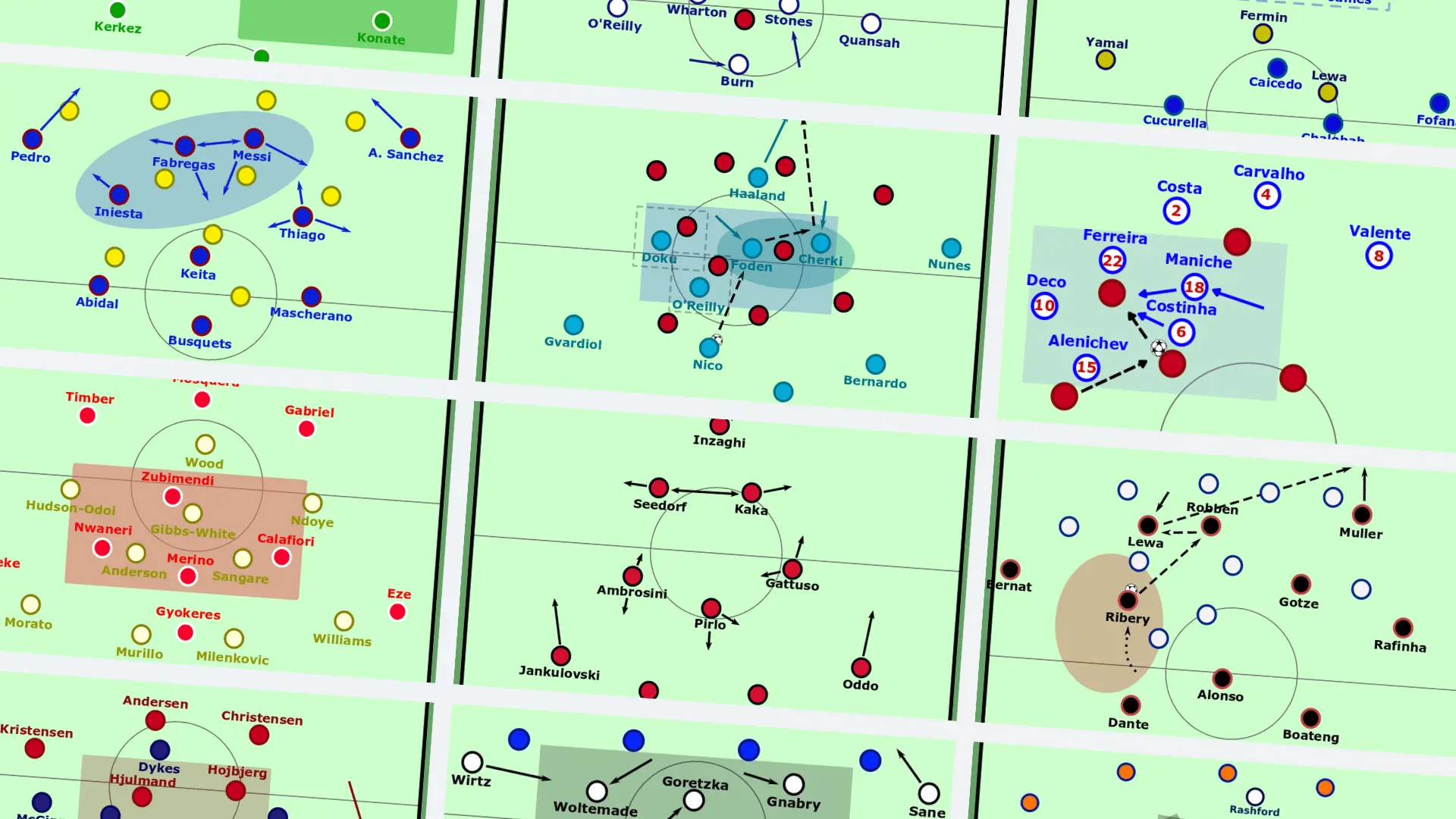
Why Tactical Explanations Often Fail
Players rarely misunderstand because they are not listening. More often, the message asks them to process too many ideas without a clear game reference. A coach may describe the formation, several passing patterns, the opposition's shape, a pressing plan, and individual roles in one uninterrupted talk. Each point may be correct, but the players cannot tell which decision matters first.
A formation is also only a still image. Football is a sequence of changing relationships. Telling a full-back to “stay wide” does not explain when to stay wide, what the width should create, or what to do when the winger already occupies that space.
Good explanations reduce this complexity. They connect an instruction to something the player can see: the ball travels backwards, the opposition full-back receives facing their own goal, the centre-forward drops, or the far-side winger moves inside. The cue gives the instruction a moment.
Useful rule: If an instruction cannot be connected to a visible cue, it will probably become a command that players wait to hear from the touchline.
Explain, Show, Rehearse, Question, Repeat
This five-part method works for a simple role reminder, a unit relationship, or a complete match plan. The depth changes, but the order stays useful.
- Explain the game problem. Start with what the team is trying to achieve and why it matters. “We want to stop their midfielder receiving forward” is clearer than beginning with eleven separate positions.
- Show the starting picture. Use players, cones, a tactics board, or a freeze-frame. Identify the ball, the dangerous space, and the players directly involved. Remove anything that does not help this decision.
- Rehearse the decision. Walk through the movement once, then put it into a small-sided activity with opponents, direction, and realistic choices. Players need to feel the distance and timing.
- Question for understanding. Ask a player to predict what happens next or explain their teammate's role. Questions should reveal understanding, not test whether players remember the coach's exact words.
- Repeat the same cue. Use consistent language in the diagram, practice, and match. Revisit the idea briefly across several sessions instead of delivering one long explanation and expecting permanent learning.
FIFA's guidance on when to tell and when to ask shows how direct instruction and guided questions can serve different coaching goals inside the same session. A coach may tell players the initial objective, then ask questions once they have enough experience to explore the situation.
Explain the Team, the Unit, and the Player
A complete tactical message has three connected levels. Begin with the widest picture, then narrow the explanation until every player knows what they are looking for.
Describe the collective result in one sentence. Examples include playing through the first line, protecting central space, forcing the opponent outside, or creating an overload on one side before switching.
Show how two or more roles help each other. If the winger presses outside, the full-back covers behind and the midfielder protects the inside pass.
Give the player a moment and an action: “When their centre-back carries forward, step out and screen the pass into midfield.”
These levels prevent two common problems. A team-only message can sound inspiring but leave players unsure what to do. An individual-only message can produce eleven correct jobs that do not connect. The unit relationship is the bridge between them.
Explain formations as relationships, not fixed dots
A 4-3-3 or 4-4-2 gives players a starting reference, not a set of permanent coordinates. After showing the base shape, move the ball to a realistic area and ask what changes. Who provides width? Who supports underneath? Who protects the centre if possession is lost?
For detailed examples of how the structure moves, use the 4-3-3 tactical guide or the 4-4-2 tactical guide. The formation becomes easier to understand when each line is attached to an objective and a game cue.
Turn Coaching Language into Player Language
Technical terms can be useful when everybody shares the same definition. Problems begin when the coach uses abstract language that does not tell the player what to notice or do.
“We need more compactness in defensive transition.”
“When we lose it, sprint inside the width of the penalty box.”
“Create positional superiority in the build-up.”
“Move where the defender cannot watch you and the ball together.”
“Recognise the pressing trigger.”
“If the touch escapes them, the nearest player goes.”
Player-friendly does not mean childish. It means observable, specific, and short enough to recall under pressure. Once players understand the behaviour, you can attach a shared tactical term to it and use that term as a fast team cue.
England Football's advice on improving communication with players also stresses helping players connect training to real football. A brief explanation is useful only if the activity allows the same picture and decision to appear.
Adapt the Detail to the Players
Age matters, but experience, confidence, and familiarity with the idea matter too. Keep the same tactical objective for the group and adjust how much information each player must hold.
| Player stage | Useful focus | How to communicate it |
|---|---|---|
| Early small-sided football | Space, direction, nearest teammate, nearest opponent | One short cue, a physical demonstration, and a game that makes the behaviour useful. |
| Developing youth players | Simple unit relationships, support angles, pressure and cover | Use a board or cones, ask one prediction question, then rehearse in 2v2 to 5v5. |
| Older youth and academy players | Shared triggers, opposition details, alternative solutions | Combine diagrams, animation, and selected match clips. Give players responsibility for part of the review. |
| Adult and senior teams | Role detail, opponent tendencies, game-state adjustments | Keep meetings focused on decisions that affect the next session or match. Separate essential information from optional detail. |
A newer player may need one position and one action. A more experienced teammate can work with two possible responses based on the defender's movement. Both can still contribute to the same team objective.
Choose the Right Moment to Explain
| Moment | Best use | Avoid |
|---|---|---|
| Before training | Introduce one objective and show the starting picture. | Explaining every progression before players have touched the ball. |
| During practice | Use a brief pause when the relevant picture appears naturally. | Stopping so often that players never experience the flow of the game. |
| Pre-match | Confirm the plan, the first cues, and set-piece responsibilities. | Adding unfamiliar concepts or a long list of opposition details. |
| Half-time | Prioritise one or two changes supported by a clear example. | Retelling the whole first half or giving every player a separate correction. |
| Post-match | Ask players what they saw, then select evidence for the next session. | Trying to deliver a full analysis while emotions and fatigue are high. |
A five-minute tactical explanation
- State the problem: “Their number six is receiving with time and turning.”
- Show the picture: Place the ball, their centre-back, their number six, and your nearest two players.
- Name the shared cue: “When the pass travels into six, lock the centre.”
- Give the jobs: The forward screens one centre-back, the midfielder presses, and the far midfielder narrows.
- Check it: Move the ball to the opposite centre-back and ask the players to reposition the team.
Worked Example: Explaining a Press
Pressing is a useful example because several players must move from one shared cue. Telling the team to “press higher” is too broad. The players need to know what starts the press, who acts first, how teammates support it, and when the team should stop.
- Objective
- Force the opponent toward the touchline and regain without exposing the centre.
- Starting picture
- The opposition centre-back has the ball. Their full-back is wide and their central midfielder is available inside.
- Trigger
- A slow pass toward the full-back or a poor first touch near the touchline.
- First action
- The winger curves the press to block the return pass and guide play down the line.
- Support
- The full-back closes the next receiver, the nearest midfielder protects inside, and the far side becomes compact.
- Check question
- “If the winger is beaten inside, which player can affect the ball next?”
Use the clip in three passes
- Watch once without stopping and ask players what problem the defending team is solving.
- Pause when pressure, cover, and balance become visible. Give each role a short label.
- Replay and ask one player to narrate the next movement before it happens.
The full youth pressing guide turns this explanation into a complete practice progression.
When to Use a Diagram, Animation, or Video
Visuals are most useful when they remove information rather than adding more. Choose the format based on the question the players need to answer.
Show starting positions, zones, distances, and the first available options. It is the clearest format when players need to understand where the problem begins.
Show which movement starts first, how a teammate reacts, and where the space appears. Keep each sequence focused on one decision rather than animating the entire match plan.
Match video supplies realism, but it also contains noise. Crop the clip tightly, pause on the important moment, and compare it with a clean tactical diagram. The board explains the principle; the footage shows what the principle looks like against real opposition.
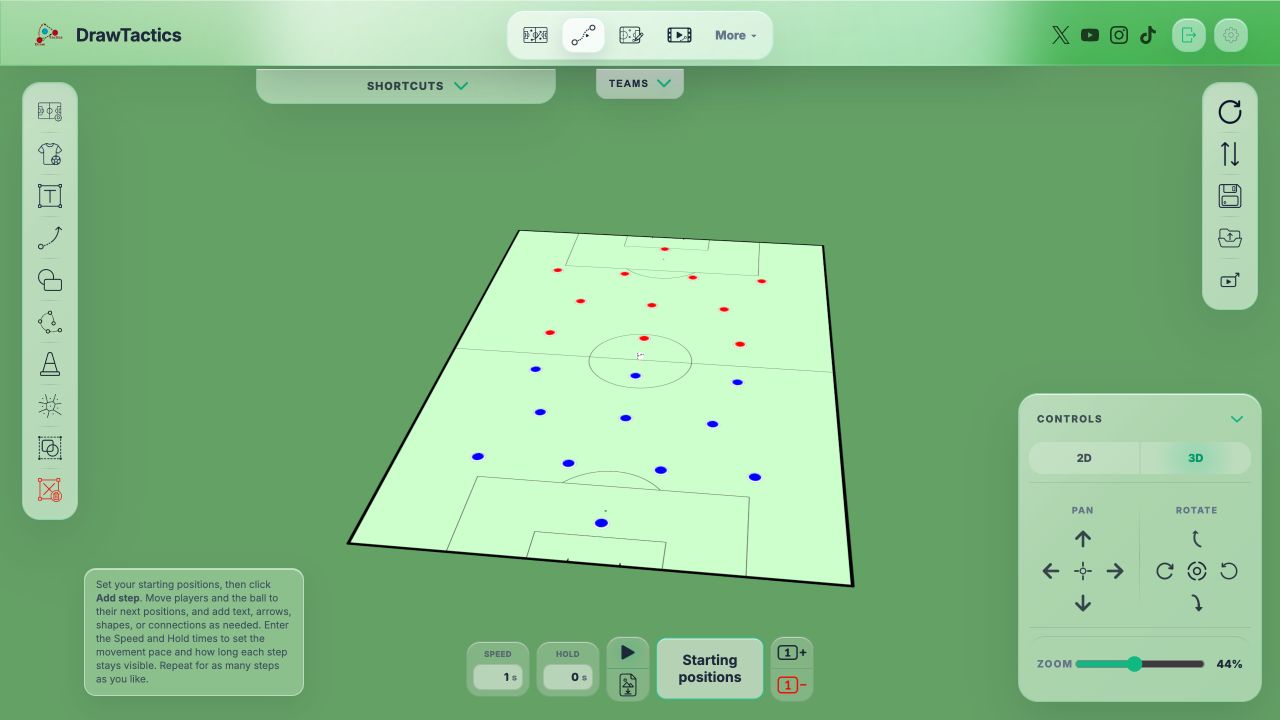
A simple DrawTactics workflow
When the visual is for a training exercise rather than a team tactic, follow the complete workflow for creating football training drill diagrams. It covers practice areas, equipment, notation, rules, progressions, and export. To put several practices together into one printable plan, use the free football session planner.
- Build the starting picture with the online tactics board. Include only the players and spaces involved in the decision.
- Add one or two arrows for the first movement. Use labels for the cue and the objective, not a paragraph of instructions.
- Switch to the animated tactics board when timing or coordinated movement is essential.
- Show the sequence, ask a player what happens next, and then recreate the problem in training.
The detailed guide to creating football coaching animations covers the full step-based workflow, notes, 2D and 3D presentation, and video export.
Make Your Next Explanation Visual
Build the starting picture, clarify each role, and animate the movement that players need to recognise.
Common Tactical Communication Mistakes
Starting with the solution instead of the problem
Players remember instructions more easily when they understand what the movement is meant to solve. Begin with the opponent, space, or moment that creates the need for action.
Explaining every possible outcome
A coach may try to prevent confusion by covering all alternatives. This often creates more confusion. Teach the most common picture first, let players experience it, and add a second response when the first is stable.
Using the board without transferring to the pitch
A diagram can prove that a pattern is geometrically possible. It cannot reproduce the speed, pressure, or imperfect information of a match. Move from the board into an opposed activity quickly.
Asking “Do you understand?”
Players can say yes without knowing how the idea applies. Ask them to move a marker, predict the next action, explain a teammate's job, or demonstrate the behaviour in a game.
Changing the cue every week
If “lock on,” “jump,” “go,” and “trigger” all describe the same action, players spend time translating the coach. Agree on a simple vocabulary and use it consistently.
Coaching only the player on the ball
Most tactical behaviour is relational. Direct attention to the nearest support, the player protecting balance, and the far-side movement that makes the team solution possible.
Frequently Asked Questions
How long should a tactical explanation take?
Most initial explanations should take only a few minutes. State the game problem, show the starting picture, give each player one job, and move into a realistic practice. Add detail later when the players have experienced the situation.
How do you explain a formation to football players?
Begin with the formation as a starting reference, then show how the distances and roles change with the ball. Explain the team objective, each unit's relationship, and the individual cue that tells a player when to move.
How can a coach check whether players understand the tactics?
Ask players to describe the objective in their own words, predict the next action on a diagram, and demonstrate it in a small-sided game. Understanding is shown through decisions, not silence during a team talk.
Is a tactics board or video better for explaining tactics?
They solve different problems. A tactics board removes noise and clarifies the structure. Animation shows timing and coordinated movement. Match video provides realism and evidence. Use the simplest format that answers the players' current question.
How do you explain tactics to players with different levels of experience?
Keep one shared team objective, then vary the detail. Give newer players a clear position and action, while more experienced players can work with triggers, relationships, and alternative decisions. Pair explanation with demonstration and guided questions.
Final Coaching Checklist
- Can the team objective be stated in one sentence?
- Have you shown the exact game picture that starts the behaviour?
- Does each unit understand how its roles connect?
- Does every player have a visible cue and a useful action?
- Will the practice reproduce the same problem with realistic opposition?
- Can players explain, predict, or demonstrate the idea without your prompt?
- Are you using the same short vocabulary across the board, training, and match?
Clear tactical communication does not remove player decision-making. It gives players a shared picture from which they can make better decisions. Explain the problem, show the relationship, rehearse it under pressure, and let the players prove what they understand.