Explaining a formation verbally rarely works. You describe a 4-3-3 with an inverted full-back and a false nine, and half the squad nods while the other half wonders why the right-back is standing in the centre circle. Players need to see structure before they can execute it.
An online soccer formation maker turns abstract instructions into clear visuals. Instead of relying on hand signals and imagination, you build the shape on a digital pitch, adjust player positions precisely, and share a diagram that shows exactly who stands where. This guide covers how to create football formations online, from selecting a system to exporting professional diagrams for your team. For analysing match footage rather than building formations from scratch, see the football video analysis tool.
Table of Contents
Choosing the Right Formation for Your Team
Before opening a football formation creator, you need to know what you are building. The formation should fit your personnel, not the other way around.
Teams with athletic full-backs who can cover the entire flank suit a 4-3-3, where width comes from the back four pushing high. Squads lacking natural wingers but possessing three solid central midfielders often play better in a 3-5-2, using wing-backs to provide width. A 4-4-2 works when you have two strikers with complementary movement and central midfielders who can cover ground.
Consider your defensive vulnerabilities too. A back three suits teams that struggle with pace in central defence, since the outside centre-backs can sweep across to cover. Two holding midfielders protect a defence that lacks speed but risks isolating your forward line.
The formation is a starting structure, not a prison. Modern football demands flexibility within shape. Start with a base that suits your players, then adjust based on opposition and game state.
Building a Formation Step by Step
Set the Pitch and Scale
Open your online tactics board and select the pitch marking style. Standard markings work for general tactical work. JDP (Technical Blueprint) markings suit academy sessions focused on specific zones. Set Piece markings highlight the penalty area and key crossing zones.
Establish scale early. A regulation pitch is 105 by 68 metres, but your diagram does not need to be architecturally precise. What matters is relative spacing. If your centre-backs are ten metres apart in training, they should look ten metres apart on the board.
Place the Back Line
Start with defenders. They provide the reference points for the rest of the shape.
In a back four, position the centre-backs centrally with appropriate distance between them. Full-backs start level with or slightly deeper than the centre-backs. In a back three, the central defender drops slightly deeper than the two outside centre-backs, creating a natural sweeping position.
Think about defensive line height. A high line compresses the space for opposition forwards but requires pace to recover. A deep line invites pressure but reduces the risk of balls in behind.
Build the Midfield Structure
Midfield placement determines your team's connectivity. In a 4-3-3, the single pivot sits deepest, with two advanced midfielders ahead. The distance between the defensive midfielder and the centre-backs should be short enough to support build-up, long enough to create passing angles.
In a 4-4-2, the two central midfielders need clear roles. One sits, one pushes. Mark this distinction by naming the players or adding text labels. Confusion between midfielders leads to gaps that opposition exploit.
Wide players require attention to width. Wingers starting high and wide stretch the defence. Wide midfielders in a 4-4-2 start deeper, protecting full-backs while offering crossing positions.
Position the Forward Line
Strikers and attacking midfielders complete the shape. In a single-striker system, place the forward high to pin the back line, creating space for runners from deep. In a two-striker partnership, stagger their positions slightly so they do not occupy the same space.
Consider defensive positioning too. A false nine starts deep to draw centre-backs out. A target man stays high to occupy both central defenders.
Name and Number Your Players
Generic positions mean nothing to a squad. Name every player on the diagram and assign their squad number. This transforms an abstract tactical concept into a concrete plan that each individual recognises as their responsibility.
Save the project regularly. Most online formation creators store work in the browser session, but saving explicitly prevents loss if you close the tab.
The 4-3-3 Example
The 4-3-3 offers balance between defensive solidity and attacking width. Build it as follows:
Back four: right-back, two centre-backs, left-back. Position full-backs slightly wider than the centre-backs, ready to push forward. Centre-backs should be close enough to cover each other but not so close that they occupy the same space.
Midfield three: single pivot at the base, two advanced midfielders ahead. The pivot lines up with or slightly in front of the centre-backs. Advanced midfielders sit between the opposition defence and midfield, ready to press or receive between the lines.
Front three: right winger, centre forward, left winger. Wingers start high and wide, stretching the back four. The centre forward pins the centre-backs centrally.
Add arrows showing the full-backs overlapping when wingers cut inside. Show the pivot dropping between centre-backs during build-up to create a back three. These movement patterns turn a static diagram into a functional tactical plan.
The 3-5-2 Example
The 3-5-2 suits teams with strong central players and athletic wing-backs.
Back three: right centre-back, central centre-back (deepest), left centre-back. The central defender sweeps behind the other two. Outside centre-backs can push wider to cover wing-backs when they advance.
Midfield five: wing-back right, two central midfielders, one advanced midfielder, wing-back left. The wing-backs provide width, so the two central midfielders stay compact. The advanced midfielder operates between opposition lines.
Front two: strike partners positioned to work together. One can drop deep while the other stretches behind, or both can press centre-backs simultaneously.
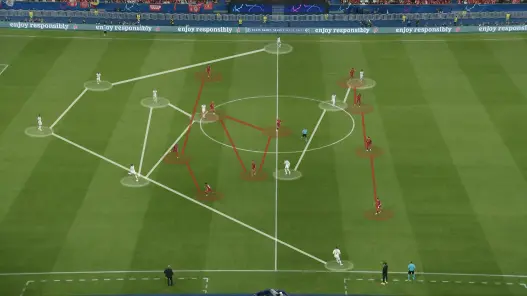
Use the online tactics board to show how the 3-5-2 becomes a 5-3-2 when defending, with wing-backs dropping to form a back five. This shape-shifting is difficult to explain verbally but obvious on a diagram. You can also analyse real match screenshots showing this transition using the screenshot annotation tool.
Adding Movement and Animation
Static diagrams show positions. Animation shows timing.
After building your base formation, open Animation Studio. Set the starting positions, add a step, then move the players and ball into the next phase. Repeat for a pressing trap, build-up pattern, set-piece routine, or training rotation. The studio creates the movement between each coaching picture automatically.
Set the movement speed and add a hold after each step when players need time to read the shape. Text, arrows, zones, and connections can appear on one step or throughout the animation, and the Draw on option can reveal them during playback.
For a complete walkthrough and a finished video example, read how to make a football animation for coaching.
Exporting for Players and Presentations
Finished formations export as PNG images for still diagrams or as MP4 and WebM videos for animated sequences. PNGs work well for printed session plans and presentation slides. Video exports suit team meetings, messaging groups, YouTube content, and social media posts.
If all you need is a starting XI with names for the team group chat, the free football lineup builder (or the soccer lineup builder for US teams) does it in under a minute.
Custom crop dimensions let you optimise for different platforms. A square crop works for Instagram. A 16:9 ratio fits YouTube and team presentation screens. The export process takes seconds, not the hours required in professional video editing software.
Organise your projects sensibly. Name each formation file clearly: "4-3-3_v_Watford_031124" or "SetPiece_Corner_NearPost". Good naming prevents confusion when you have twenty formations saved and need to find the right one quickly.
Start Creating Football Formations Online
DrawTactics provides a browser-based football formation creator with drag-and-drop positioning, 2D and 3D views, step-based animation, and export options for images and video. It costs £5.99 per month. No software installation required.
Get Started →Conclusion
Creating football formations online replaces verbal confusion with visual clarity. A soccer formation maker lets you build precise diagrams, add movement paths that show timing and coordination, and export professional visuals for any context.
The process is straightforward: choose a formation that fits your players, build the structure on a digital pitch, name and number every position, then animate the key movements that bring the shape to life. Players understand what they can see. Coaches who show rather than tell get faster comprehension and better execution.
DrawTactics provides a browser-based football formation creator with drag-and-drop positioning, 2D and 3D views, step-based animation, and export options for images and video. It costs £5.99 per month. No software installation required.