End Zone Game for Soccer
The end zone game for soccer works like a touchdown: a team scores when a player runs into the zone they are attacking and receives a pass there. There are no goals, so the focus moves from shooting to the pass and run that break a defensive line.
- AgesU8 to adult
- Players6 to 16
- Space40 × 30 m
- Time20 min
- IntensityHigh
It develops the timing of forward runs, the weight of a through pass and the patience to keep the ball until the run is on. Defenders learn to track runners rather than watch the ball. It is a good bridge between a possession game and a game to goals.
Setup
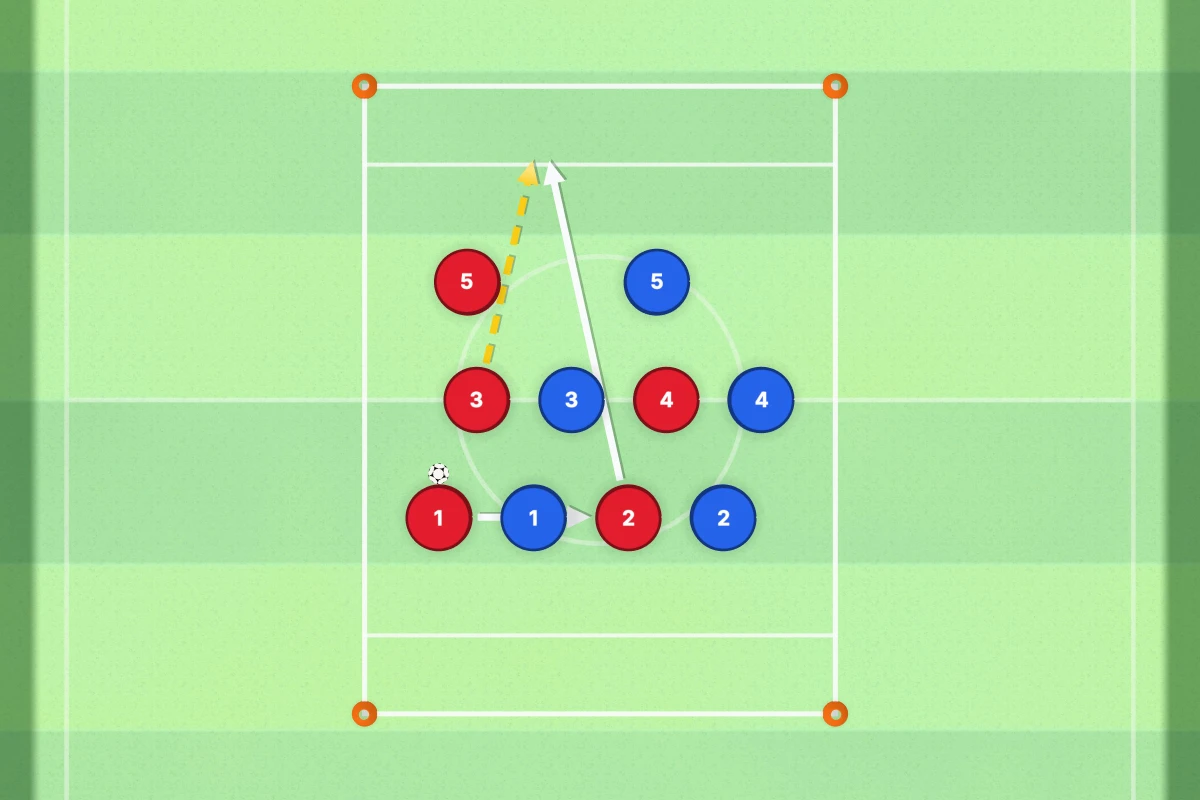
Mark a 40 × 30 m area with a 5 m end zone at each end. Play 5 Reds against 5 Blues, 10 players in all, in the space between the zones. A team scores when a player runs into the end zone they attack and receives a pass there; players can't wait in the zone before the ball is played. After a score, the team that scored keeps the ball and attacks the other way.
- EquipmentDiscs or cones to mark the end zones, Bibs, Supply of balls
How it works
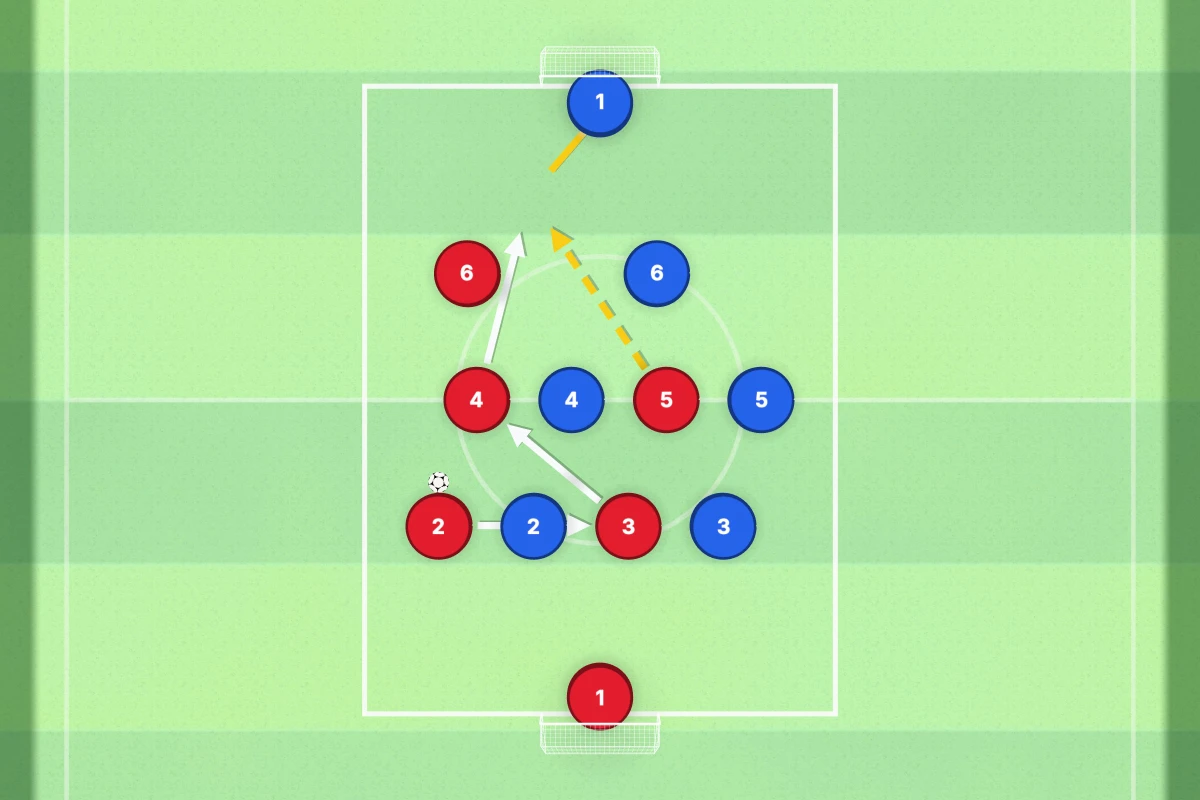
- A Red passes to a teammate in the middle of the area, and the nearest Blue steps up to press.
- Another Red times a run into the end zone, receives the pass there to score, and a second Blue arrives too late on the passer.
Coaching points
- Time your run into the zone so you arrive with the ball, not before it
- Look for the pass in behind as soon as the defense steps up
- Width on both sides stretches the defense and opens gaps
- Defenders track runners into the zone instead of watching the ball
- Pass into the runner's path so they can receive without stopping
Make it harder
- The receiver must stop the ball dead inside the zone
- Defenders are allowed into the end zone
- A pass must cross the halfway line before a score counts
Make it easier
- Add a neutral who plays for the team in possession
- Make the end zones deeper
- Allow a player to dribble into the zone to score
Adapting it by age
U8–U10
Play 4v4 in a 30 × 20 m area with 8 m end zones, and let dribbling into the zone count as well as receiving a pass. Keep the rules simple.
U12–U14
Use the default 5v5 at 40 × 30 m with 5 m zones. Add a neutral if scores are rare, and introduce the stop-the-ball rule once runs are well timed.
U15 to adult
Go 7v7 at 50 × 35 m, let defenders into the zone and limit players to two touches. Add an offside line at the edge of the zone to sharpen the timing.
Common mistakes
Attackers stand in the end zone waiting for the ball. Only count a score when the receiver enters the zone after the pass is played.
Every attack is a hopeful long ball toward the zone. Require three passes before a score counts, so the team has to work an opening first.
Nobody stays wide, so the defense stays compact and blocks the middle. Ask for one player near each side line in possession and point out the gaps that appear.
Defenders turn and watch the ball instead of the runner. Coach a side-on stance that lets them see both, and give a point for intercepting a pass into the zone.
FAQ
How does an end zone game work in soccer?
Teams score by passing to a teammate who runs into the zone at the end they attack, instead of shooting into a goal.
How deep should the end zones be?
About five meters suits most groups. Make them deeper for younger players or to make scoring easier, and shallower for older players.
Make this drill your own
Open the end zone game for soccer in DrawTactics to change the numbers and the size of the area, move the players, and export your own animation or diagram for your team. Or add it to a free session plan and print it.
Animate it in DrawTacticsRelated drills
Gates Passing Game for Soccer
Score by passing through a gate to a teammate on the other side.
Playing Through the Thirds Soccer Drill
Build from one end to the other, zone by zone, with an overload in each third.
Possession Drill with Neutrals (4v4+3)
Keep the ball with the help of neutrals who play for whoever has it.
Small Sided Game with Goalkeepers (5v5)
A game with keepers and full-size goals, to finish the session.
More in possession drills, small-sided games drills, or browse the full drill library.